Thursday, April 20, 2023

A Poem for your April Heart


Spring Desire Paths


Lunacy and moonacy,

June plums and camas,

Pink, white and red flowering currants,

Maple buds and Saskatoons.

Salmonberries, bog blueberries,

Red huckleberries emerging from nurse stumps,

Arbutus and hairy manzanita,

Pussy willows, and blue-eyed Mary.


Follow the spring bloom with your heart.

Take the pollen path, trace the nectar map.

Follow the queen bumble bees, the frigid mining bees,

Blue orchard mason bees.


Follow the buzz into your heart,

Deep into your sense of purpose and grace.


LDW

Wednesday, April 19, 2023

Satyr Comma in the Heart of Vancouver


I visited the community garden at Vancouver City Hall and spotted a Satyr Comma butterfly on the Pieris japonica. It was really intent on sipping up that nectar so I was able to get some good shots. I am so grateful for meeting this wonderful creature. Japanese Andromeda is also a popular shrub with queen bumble bees and blue orchard mason bees. If you underplant it with kinnikinnik and surround it with native shrubs like red-flowering currant, osoberry and Oregon grape, it will function even better to support pollinators in your garden.


Note how the undersides of the wings perfectly mimic dead leaves.


Saturday, April 1, 2023

Desperately Seeking Pussywillows


The little English daisies are blooming in the lawn at Riley Park. The blossoms have short white petals, often tinged with pink around a circle of short yellow stamens. As I walked around the park I noticed a child had made an assemblage of ephemeral art with twigs, pine cones and daisy blossoms they’d plucked from the lawn. I also noticed a discarded item of winter clothing—a little orange toddler parka. It had been thrown aside, as if spring itself had thrown away winter. Time for me to shed my long winter jacket and toque. Time to wear something shorter, lighter, giving me more range of movement to bend down and take photos of ephemeral art. Time to wear a hat with a brim to shade my eyes from the brilliant sun. Time to put on 50 spf sunscreen. 


A man in an orange safety vest came and swept the collection of daisies and other objects away with his boot. Can’t have people tripping over the art, I guess. He picked up the jacket and put it in the playground so the owner could come back and find it there. In that moment I felt so happy for the child who had lost the jacket. I imagined that they were experiencing the transition to warmer weather, and feeling the sun on their skin. They wouldn’t fit into that jacket next winter anyway. This little human was like an insect, shedding its cocoon to emerge as a larger creature in the next stage of its life. I tried to convince myself I should do the same. I mean I’m not going to leave my coat on the sidewalk, but it does need to go back in the closet for next year.


My heart is gradually opening up to spring. I am breaking out of winter’s sheltering cocoon. My heart feels cautious, as if a bit frost bitten. Afraid we might have another cold snap like we did a few weeks ago.  But I am so hungry to welcome spring into my body and soul. I am ravenous for it. Two days ago I needed to get out and be in spring. I picked up some of the fuzzy grey calyxes that drop from the magnolia flowers as they open on Ontario Street, south of King Edward Ave. I want to use them to make art. As a prairie person, it’s taken me a while to befriend the magnolias, since they appeared quite exotic and gaudy to me. But now I love their ostentatious blossoms and soft, furry buds. Most petals are pink or white, but occasionally one sees a yellow-blossomed magnolia too. Kneeling and bending to pick up the velvet treasure feels good, but I know my muscles will ache tomorrow. Too much time spent in a cocoon, writing, drawing and dreaming. Time to emerge and start making and experiencing the seasons deep in my bones.


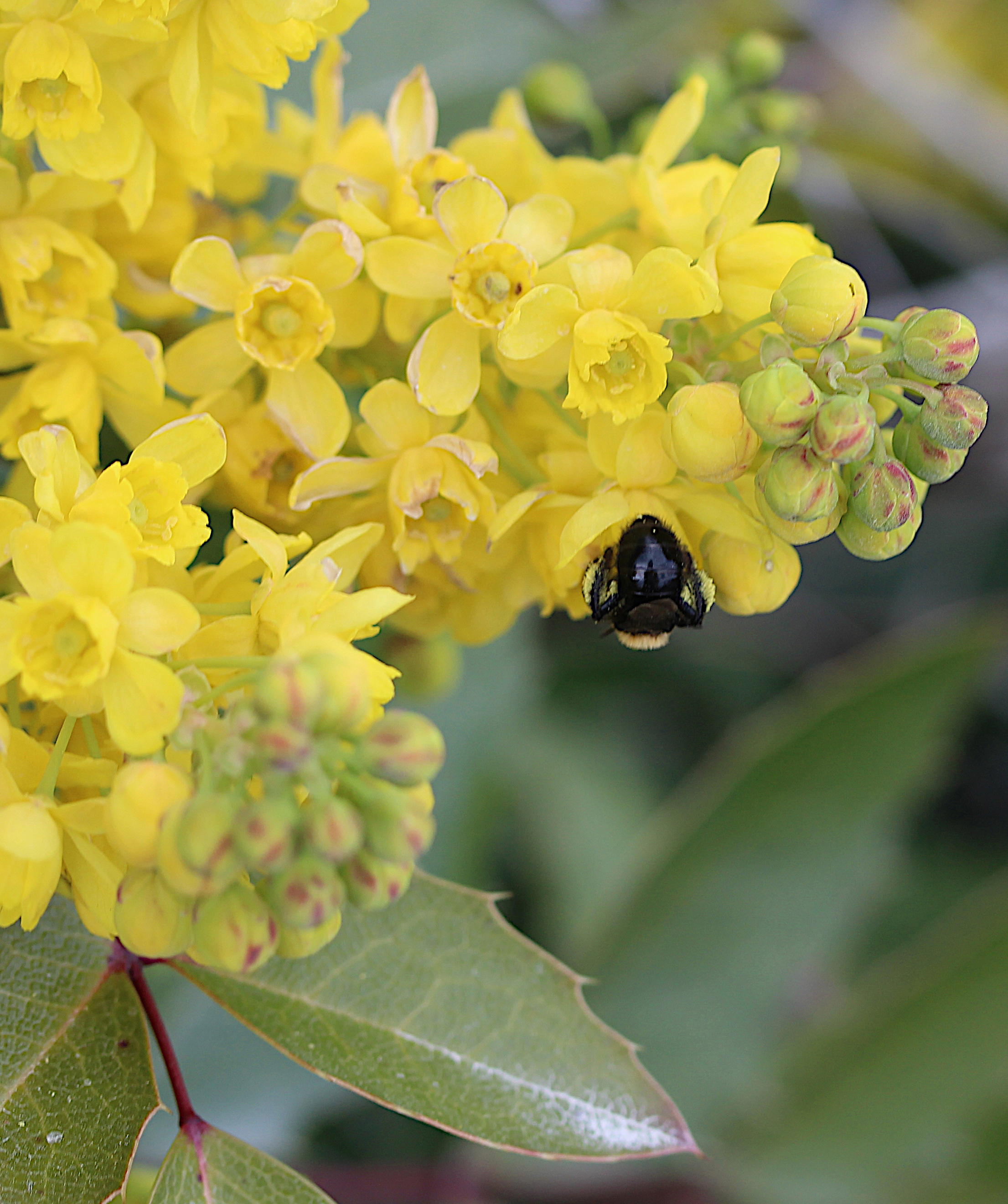
 One day last week I saw a juvenile hawk watch crows making a nest. It was making a curious kekking sound and not being surreptitious in the least. It eventually left with one worrying crow chasing after it. A few days later, I saw two crows mating on a branch next to their handiwork. The bees have been emerging as the temperatures warm. So far I’ve seen several queen bumble bees, and a very early male mason bee. The first mining bees and sweat bees are slowly starting to appear. I watch them come in as observations on the NBSBC Bee Tracker. The crocuses pop up in lawns, the heather blooms, and the osoberry and red-flowering currant open. The clusters of bright yellow Oregon grape flowers are just starting to open, and the satin flowers, lungwort and blue-eyed Mary are blooming as well. Remembering my experience from last spring I knew I needed to go to Queen Elizabeth Park to see the insect action in the pussy willows. The bumble bees were doing their orientation flights up just above the blooming willows. I stood under them, feeling them fly circles over and around me. I took it in as a blessing. How many generations of Bombus queens have performed this ritual here every spring? Do people realize how important willows are in our ecosystems?


A velvety mourning cloak butterfly floated over the willows toward the sun. In the distance a woodpecker was hammering away somewhere on a dead tree and a male Anna’s hummingbird was doing it’s “Skreep!” territorial dive--sounds made by its wings whistling in sharp descent. I lay on the grass for a bit, breathing in the fresh air and a small movement on the ground caught my eyes. I saw a queen fuzzy-horned bumble bee emerging from her hibernaculum in the dead leaves under the willows. What a marvelous thing to witness! The great awakening! She lifted up and few off before I could take a photo, circling up and above the willows again and again to orient herself to spring and its infinite possibilities, including the dangers that all queen bees face as they seek out a place to make their nest close to an abundant and reliable source of pesticide free nectar and pollen. I wish her well. My heart is full of hope for her and for us delicate humans, daring to hope for all the beauty spring has to offer our hearts, filling us with hope once again. 


Your mission, should you choose to accept it, is to find some blooming pussywillows. Immerse yourself in the activity of the bees, birds and butterflies and convince your heart to open to the awe-inspiring beauty of spring.


Saturday, November 19, 2022

On Mending and Grieving: An Artist Residency at the Comox Valley Art Gallery


I am so excited and grateful to be in Courtenay in this artist residence! What a beautiful, supported place to work! Thank you to the people at the Comox Valley Art Gallery for this wonderful opportunity!


Part of my process every morning has been reading Mary Oliver’s beautiful poem Wild Geese  and writing a response as if I was addressing the poet directly. Having just come from a trip, joining photographer Darren Kirby on his cross-Canada trip, following the fall migration of geese across the prairies and British Columbia, it speaks to me quite deeply right now. Sadly, we lost Mary Oliver in 2019.You can hear here reading the poem here. She left behind a legacy of poems that have changed people’s lives. I invite you to look through her collections and engage deeply with the ones that touch your heart.


As an artist, I am always trying to find my place in the “family of things” she speaks of in the poem, the order of things and mourning the ongoing loss of the stability of nature as a consoling, organizing force. Climate change and human intervention threatens the very fabric of nature, and so part of my current artistic process is mourning the degradation of the natural world. I try to focus on the positive things we can do to repair, rewild, and regenerate nature, but at the same time I have to let my body mourn the losses of so much—so much prairie, grasslands, bogs, wetlands, insects, birds, and particularly the bees I have become so fond of over the last decade. Of course, all this ties in to the people I have lost in my life too. They have left big empty spaces in my heart that haunt me every night and day.


Dear Mary

 Nov 14

Hunger takes so many forms. Every day it’s different. The body is so demanding I can’t keep up with its needs. This body imagines it inhabits so many other bodies. It always has tried to escape itself. Wild geese, wild swans, wild horses, wild hares or wild foxes curled up in a snowbank or a cave, sheltering from the heart of winter. Which one are you in this moment? What then, Mary? What of the imagined body?

There was a songbird that waited too long to migrate south. She stayed on an icy branch with cold feet, feet so cold she fell off the branch. The shrike pinned her on the barbed wire fence.

Which bird are you, the sparrow or the shrike?

Where is our place in the family of things? Yours and mine?


I have recently been travelling to seek solace in nature, and let it do its work on mending my broken heart. But the process doesn’t have an ending . . . I can see the mending is going to have to continue every day until the rest of my life. Every day I see a new tear in the fabric of nature and the fabric of my soul—a part that needs fixing. It becomes overwhelming. And I know if I am feeling overwhelmed, then the people that are more vulnerable than I am are even more overwhelmed. I am seeking ways to come together to grieve and share the burden of collective grief. How can we support each other in mending and grieving?


What are your daily rituals of mending and grieving?


During my residency I have focused on creating a project that will culminate in one or more events memorializing the worst recorded loss of native bees. June 17, 2023 will mark the tenth anniversary of the Wilsonville Bee Kill, the largest native bee kill ever recorded. This catastrophic loss of an estimated 100, 000 bumble bees occurred when 55 linden trees in bloom in a Target parking lot in Wilsonville, Oregon were sprayed with a neonicatinoid pesticide (brand name Safari), which was being used to kill aphids that were dripping sweet sap onto parked cars. Ten years later, I am interested in revisiting this event and memorializing the bumble bees that were lost, with a community art project.


I’ve started by repeatedly drawing the shadow of a pinned Bombus vosnesenskii bee that I found dead under a linden tree in Vancouver. This repetitive gesture is somewhat comforting, but also it focuses my attention on the troubling issues I want to confront with this new work.


Thursday, September 8, 2022

Herbs for Humans and Bees: A List of Resources


Many edible and medicinal plants are a boon for humans and bees. You can create an “herbaliscious” garden that fills your pantry while feeding pollinators. There are some edible annuals that are easy to grow and some perennial “keystone” herbs which are an essential part of the infrastructure of a healthy pollinator garden.


Books on Growing and Using Herbs: 


Food Forestry North of the 49th by Richard D. Walker


“A food forest is not your typical Canadian forest. Rather, it is a planted garden that aims to mimic the ‘closed loop’ of self-sustaining biological system of a natural forest with the added benefit of growing food and medicine.”


“If I were King of the World I would decree that all communities require nature corridors, even if they go right through the middle of corporate office grounds, institutions, highways, and thoroughfares. We would use the same jurisdiction as used for pipelines, highways and cell phone towers.”


--Richard D. Walker, Food Forestry North of the 49th


Grow Your Own Drugs: The Top 100 Plants to Treat Arthritis, Migraines, Coughs and More by James Wong


The Lavender Gardens: Beautiful Varieties to Grow and Gather by Robert Kourik


The VanDusen Cookbook: Flavours of the Gardens (A collection of recipes from the members of the Vancouver Botanical Garden Association) ie rosehip jelly and nettle soup


Homegrown Tea: An Illustrated Guide to Planting, Harvesting, and Blending Teas and Tisanes by Cassie Liversidge


Drink in the Wild: Teas Cordials, Jams and More by Hilary Stewart


Edible and Medicinal Plants of the West by Gregory L. Tiford


Wild Berries of the Pacific Northwest: on the bush . . . on the table . . . in the glass by J.E. (Ted) Underhill


Pacific Northwest Foraging: 120 wild and flavorful edibles from Alaska blueberries to wild hazelnuts by Douglas Deur


Edible Wild Plants and Useful Herbs by Tim Meuninck


Online Resources:


Richter's is a wonderful company that sells herbs based in Ontario and their catalogue has a wealth of information on growing herbs: https://www.richters.com/


Horticultural Centre of the Pacific Ethnobotany Trail


Haikai Magazine The Local Carb Diet


The Wondersmith: Exquisitely presented art and recipes, ceramicist


 Wild Bee Florals: Edible flowers grown in the Comox Valley: artist and flower farmer


Pascal Baudar: Wild food artist, ceramacist


Unruly Gardening: Using selfheal (Prunella vulgaris)


Go Hiking: Cooley’s Hedge Nettle


‘Ornaments Are Great But It’s Better If You Can Eat Them’

Edible flowers are back on trend. An explainer by Sonal Gupta


Sunday, April 24, 2022

Uncanny Valley: I Thought I Saw a Saw Fly


Becker Park on the hill is a place I can walk to from the artist retreat and so I try to get up there every other day. It’s become a ritual and I have my favourite entry points, plants, bees, trees, and trails. Yesterday I was physically tired, so I gave myself a talk before I went up the hill, “Don’t take any unnecessary risks. Don’t fall on any broken glass. Don’t slide off the steep edge of the ridge on loose stones. Be careful up there.” There’s a place where the arrowleaf balsamroot blooms that is incredibly steep, so I decide it would be better to avoid those patches today and save it for a time when I have more mountain goat energy. It’s funny how some days the blossoms can be loaded with bees, and other days, there’s no joy at all. Other flowers nearby become more attractive, the nectar runs out, or I’m just unlucky with the timing of my visit. But right now, they are my favourite flower blooming on the hill. They pull me up the hill with their sunny yellow magnetism, but today it’s the action in the Amelanchier that gives me a surprise adventure.


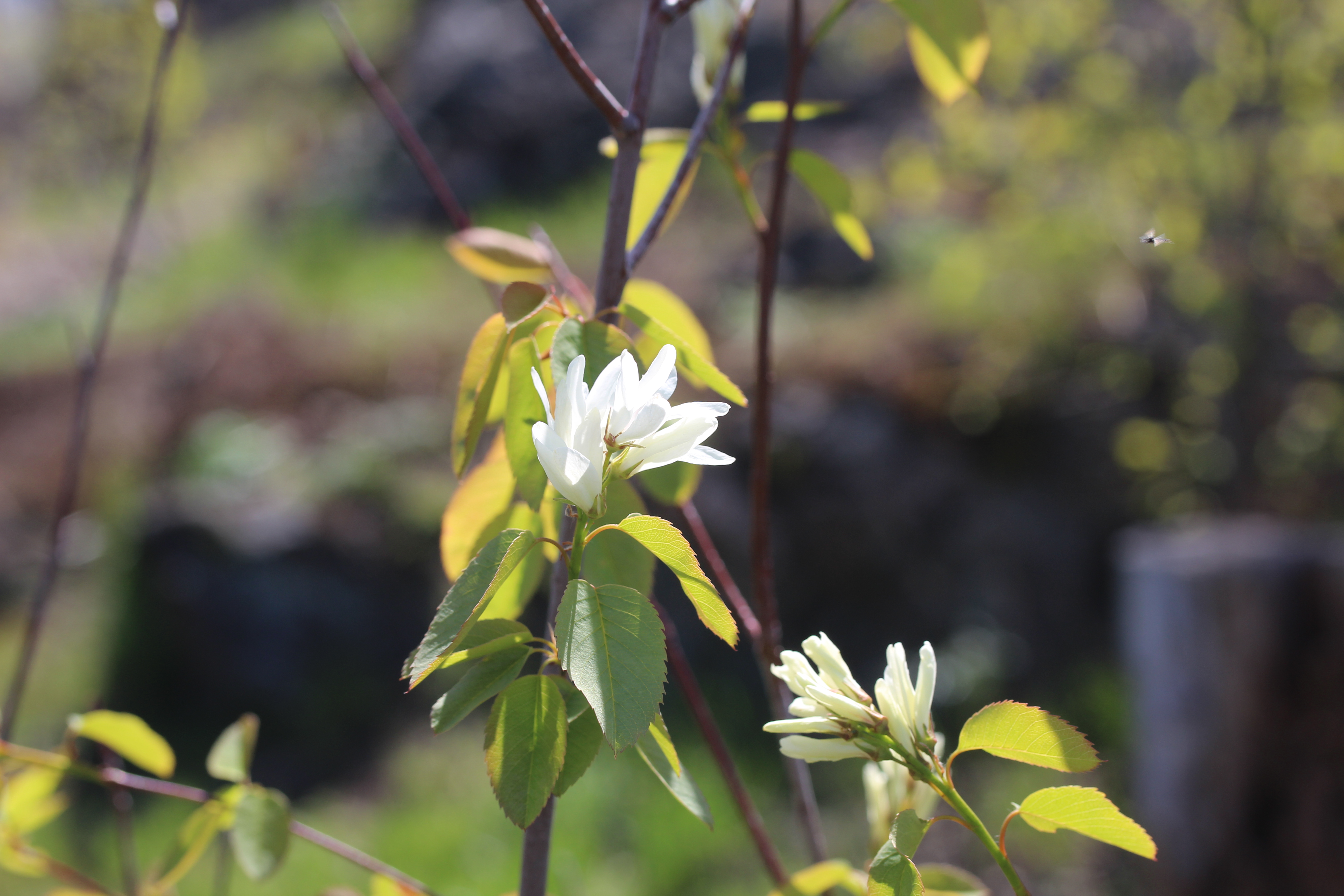
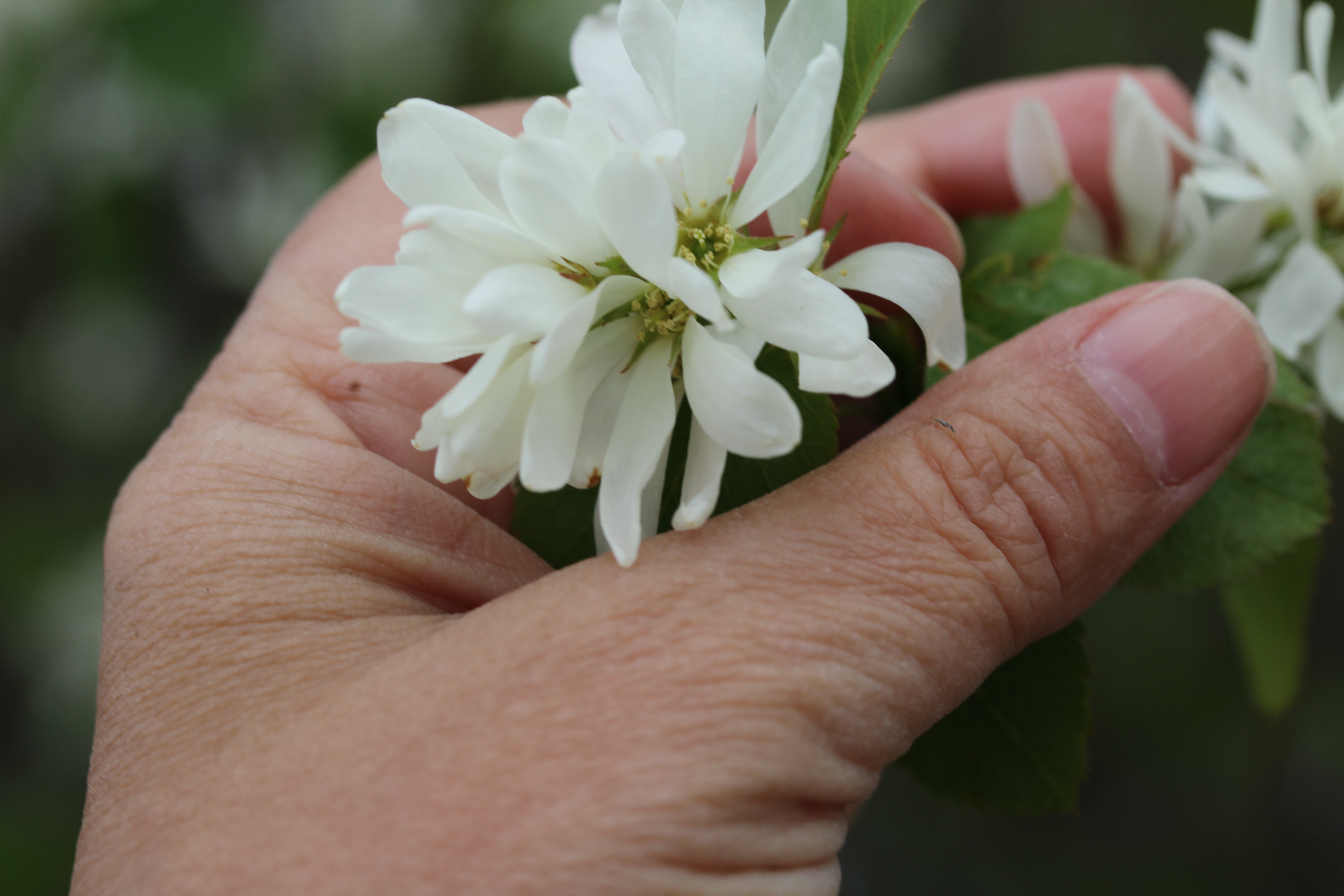
The Saskatoon berry bushes are suddenly in bloom and so I’m also on a quest to see what pollinates them because I just don’t tend to see bees on them. Today I notice there are some male bees lekking on a bush and I miss getting a shot of a female bee grooming herself on a leaf. She had pale yellow pollen on her back legs—some kind of mining bee. I also see a tiny wasp-like critter, but can’t get a clear shot. Maybe tomorrow. I might need to net some of these pollinators and look up close in a jar. Then on the top of the hill I get a surprise—three large insects are chasing each other around a Saskatoon bush. I try to get a bead on what they are—not bumble bees, but a similar size. Maybe wasps? But they seem too broad and hairy. As I move in closer to get shots I get that “uncanny valley” feeling because this insect is so unfamiliar to me it feels like a dream. I had a similar experience one when I saw my first tachinid fly. The head shape did not fit with my concept of typical fly anatomy. It looked like something someone created in a 3-D printer and then animated it somehow.


And then the unexpected happened, which made the experience even more dreamlike: the three insects started chasing each other. “Mating or fighting?” I wondered as I followed the action with my lens held tightly against my eye. They landed on the dusty ground and appeared to wrestle vigorously with one another. This seemed like a test of male fitness. After a few moments of tussling they disengaged and flew off in different directions. They were clumsy flyers and I must admit I had a shiver of revulsion at the thought they might land on me and continue the battle. I rarely have that feeling about insects, so I had to step back, get some distance and examine my reaction. At the base of this reaction was fear and unfamiliarity. I didn’t know if these were stinging or biting insects. Upon examining the photos later, I see they have very large mandibles and I’m curious what they’re used for. If these are males, they are using them for fighting and possibly mating, since that’s while the “tools” on male anatomy are usually evolved to do. Something in my brain told me these were saw flies, which was confirmed by entomologist Lincoln Best. I'd just never seen them this large and I don't see saw flies very often at all--especially giant pugnacious saw flies.


I think one of the things that tends to get under one’s skin is not knowing which direction an insect may head toward. With bees you often get a clear sense of trajectory as they go from flower to flower and flower to nest. They’re just not into humans and are very good at keeping out of our way. We humans want to stay out of their way so they can do their work. The more we disrupt their work, the less likely they are to survive. We are creatures of disruption. We are the interlopers here. When you grow up with mosquitoes, you know the irritation of avoiding insects that want to drink your blood. Horsefly bites are not much fun either. But when you grow up as a free-range child in the country you get stung and bit by insects, scraped and poked by thorns, and you inevitably end up picking soil and pebbles out of a skinned knee. But the next day you get out there and do it again. Unless you’re my wee neighbor Sidney. I have a vague memory of mom telling me he suddenly became afraid of bugs and wouldn’t leave the house. “Should I be afraid,” I wondered? And I was, for about a week, then I forgot about the fear and went on getting poked and scraped.


“I’m afraid of trees,” my friend’s nephew admits as he looks up from a game on his cell phone. “Hold on,” I thought. Where did that come from? I’m absolutely flabbergasted. This is coming from a woman who can be seen regularly getting up close to inhale the heady butterscotch scent of Ponderosa Pine bark as if it were the sun-warmed chest of a lover at the beach. I am worried folks think I’m nutty for getting too close and personal with a pine tree. But to be afraid of individual trees? Oh dear, what has technology done? It’s seduced children and their parents away from the hills, bees, trees and uncanny saw flies. We need to help children from a young age simply get used to being in nature with a biodiversity of insects, plants, trees, ecosystems, and weather. We need to teach them how to be safe in potentially dangerous situations. We need to face an element of risk in order to create deeper relationships with nature. Oh and yes, I did fall on a prickly pear pad with my full weight onto my hand. It hurt like hell. I pulled out the thorns as best I could. Drank some gin. I’ll still head out there today and take the same damned risks all over again. But my attitude toward the saw flies will have changed because now I know a little bit more about what they are, and my fear has turned to curiosity.


What inspires you to face your fear of critters that move in unexpected ways? I’d love to hear your stories.


Special thanks to Lincoln Best, who IDed the mystery critters as club-horned sawflies.