Showing posts with label Victory Gardens for Bees. Show all posts
Tuesday, July 16, 2019
Mapping Pollinator Hotspots in the Riley Park Community Garden
This week I'll be working with the community to map the pollinator hotspots at the Riley Park Community Garden and logging the types of pollinators that are visiting the garden at this time of the year. Our main event is the workshop on Saturday afternoon from 1:30 pm to 3 pm, but I am getting a head start on targeting and labelling some of the key plants and pollinators we'll be studying. Today I noticed this female turquoise sweat bee sunning herself on the petal of a purple coneflower (Echinacea purpurea) plant. Then she started scanning the soil underneath the plant for her nesting hole where she lays her eggs and provisions the nesting cells with pollen.
Lucky for her, there are patches of bare soil under the plant. She was searching for a hole, but seemed unable to locate it. Or perhaps she was deciding on the best location to make a new nest. Bees memorize the objects and plants around the nest hole in their own kind of mapping exercise. I noticed this plant growing under the Echinacea. It's a "weed" called common purslane (Portulaca oleracea). In doing research on vegan forms of Omega 3 fatty acids, I discovered that this is a very nutritious plant and an important one in the vegan diet. I recently saw an online post by a farmer who wanted to know what herbicide to use on it. Rather that killing it, he should be harvesting and selling it! It's delicious in salads. I've made a Greek salad with it, which is fantastic, and I'm sure you could puree it, freeze it in ice cube trays and put it in smoothies. Studies are showing the plant is full of omega 3 fatty acids and antioxidants. I buy mine at the UBC Farmer's market from the Mayan gardeners.
I'd never seen common purslane in bloom until now, so we much check to see if the pollinators are using the blossoms. In any case, it's a nutritious ground cover that can serve as a sign post for ground-nesting bees and a healthy food for humans.
Please join us on Saturday to look for bees, butterflies and more!!!
Saturday, March 31, 2018
The Bee and Butterfly Festival in Centre Valley, California
"You're going to California!" my friend exclaims. "What for?"
"A pollinator festival", I reply.
"Is that a thing? she asks.
"Yes it is, or is should be a thing." I say.
What does a pollinator festival look like? Well, it can take as many forms as there are venues, so I wanted to share images from the Bee and Butterfly Festival created by the library in Center Valley California. First of all, you need a leader, someone who has vision, creativity, energy and a huge heart. Laura Zuckerman, the library's director was the festival's leader and motivator.
Crafts! A pollinator festival needs drop-in family friendly crafts that are also eco-friendly. Loretta works with the youth at the library and she graciously drove me around to the schools where I worked with budding farmers and potential bee gardeners.
Costumes! You can't have a festival without pollinator costumes. Keep a stock of them on hand for the special occasion.
Crafty beekeepers!
Local gardening support! The Master Gardeners created a beautiful display and shared helpful gardening tips and resources.
And of course giving away and/or selling seeds and plants is one of the most important parts of a pollinator festival. Bees gotta eat and you need to plant something for them to tuck into. In California that means planting bee plants that bloom all year round!!!!!
Getting a local lavender farm involved is also a bonus, especially when it is a lovely ORGANIC farm tucked away in the hills with a pool and luxury glamping tents. You should go!
Food trucks are a fantastic addition to a pollinator festival. (The scones were especially delicious.)
And in SoCal, there's gonna be honey. The dark, rich winter honey infused by All Natural Soaps comes from eucalyptus and avocado trees.
Many of the beekeepers are also displaying mason bee homes. Haven't you heard? Bee hotels are the new bird houses! The more beekeepers learn about native bees, the better they will understand the impact that keeping non-native bees has on their local bee population.
I had some fantastic conversations with Tracy Ellis, an ag scientist for the County of San Diego and Leah Taylor from the UC San Diego--lots of food for thought.
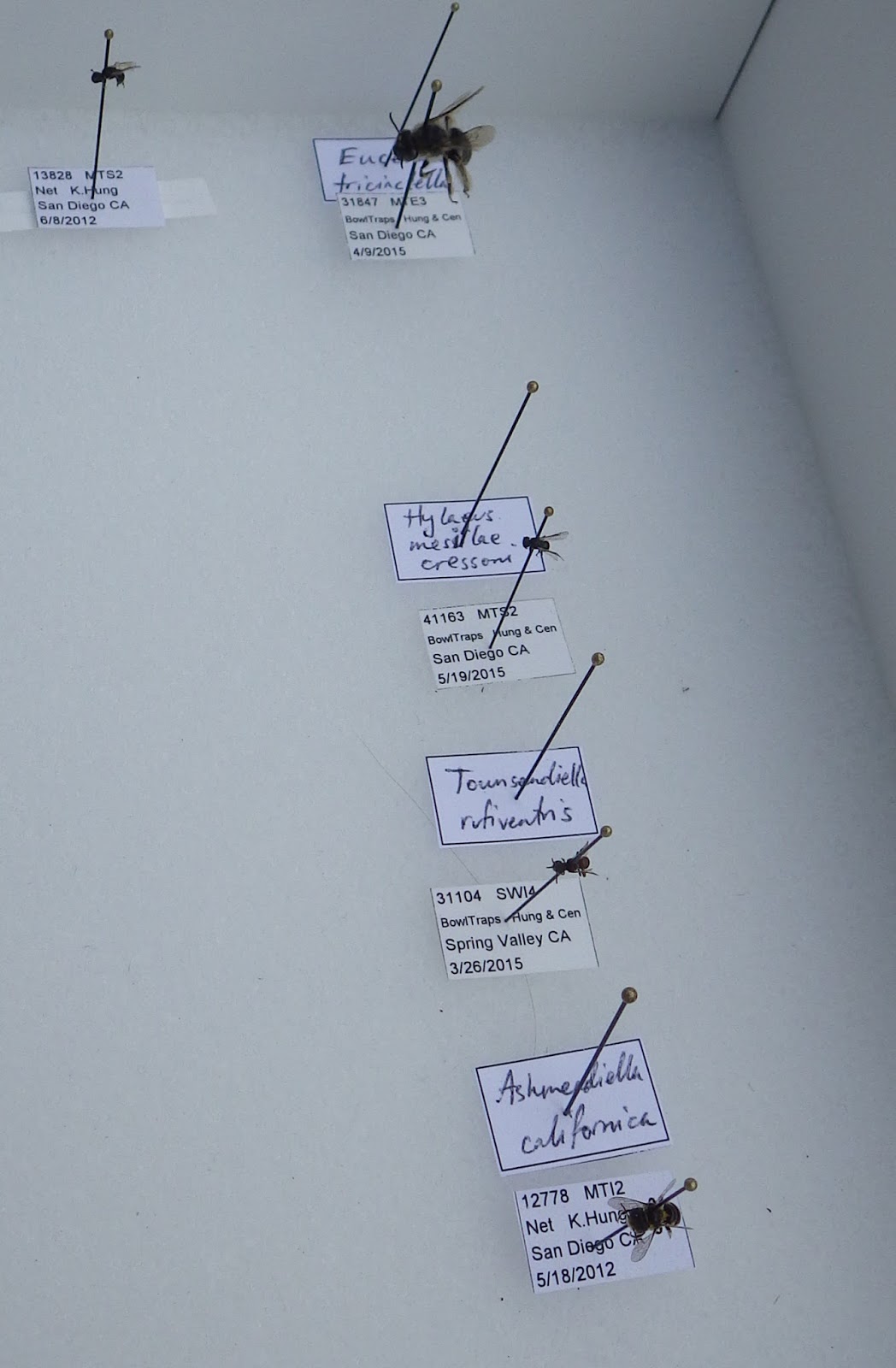
It's great to have a load of local specimens so folks can see the amazing biodiversity of insects in the local flora.
And beeeeeeeees!!!!! Ya gotta have bees! Many of these specimens were collected by an awesome bee scientist named James Hung. Check out his website here!
This is also amazing--having the plant specimen surrounded by the associated insect visitors.
Did you know there's a water bug called a toe biter? Yikes!
I was really hoping to see a live large carpenter bee (Xylocopa). However this specimen, shown by Annika Nabors, was as close as I came to one!
What a great idea for the face painting station! Point at the picture and you get what you asked for.
Quizzes! There was also a festival passport which children got stamped at every station to receive a prize.
The local ecologists had a lovely table. (Note the mug on the left--the hermit of hellhole canyon--mythical or real dude?)
The Master Gardeners also had a fantastic butterfly gardening display.
Duuuude! That's who's wearing the mysterious bee costume.
And introducing Carlotta the Cuckoo Bumble Bee!
There's also a nature trail with signage just adjacent to the library.
And this is where I was able to take a photo of a sweet little native bee, ending the festival on a personal high! Thanks to everyone who made this event possible. Long live the Valley Bees!
For those people who want more fantastic resources for gardening for bees in California I have three additional book recommendations (aside from my book Victory Gardens for Bees):
California Bees and Blooms: A Guide for Gardeners and Naturalist by Gordon
W. Frankie, Robbin W. Thorp, Rollin E. Coville, and Barbara Ertter
Field Guide to the Common Bees of California: Including Bees of the Western United States by Gretchen LeBuhn
Wednesday, January 27, 2016
Labeling Honey: An Awesome Infographic
I'll admit I have a serious Pinterest habit. As a visual person, I find it gives me a break from the sea of text I negotiate all day long. So when someone creates an infographic designed to integrate text and image, I take my hat off to them. Especially when it has to do with information about bees.
Honey is a sacred medicine and should be treated with reverence. If you love honey, then please think about how many acres of flowers it takes to support the bees that make it. If you love flowers, grow honey plants without pesticides--lots of them. If you would like more information about this topic, follow this link.
For even more information about what you can do for bees, my new book Victory Gardens for Bees: A DIY Guide to Saving the Bees if available for presale and will be released very shortly!

foodpackaginglabelslabels.net
Honey is a sacred medicine and should be treated with reverence. If you love honey, then please think about how many acres of flowers it takes to support the bees that make it. If you love flowers, grow honey plants without pesticides--lots of them. If you would like more information about this topic, follow this link.
For even more information about what you can do for bees, my new book Victory Gardens for Bees: A DIY Guide to Saving the Bees if available for presale and will be released very shortly!

foodpackaginglabelslabels.net
Subscribe to:
Posts (Atom)