Showing posts with label bee habitat. Show all posts

Thursday, August 25, 2016

Bees in a Field of Phacelia: The Sharing Farm Hosts a Bumblebee Party


It's great to see a concerted effort to plant bee forage at The Sharing Farm in Terra Nova Park.


As you can see here, there is borage, mustard and sunflowers all along this fence, and the honeybees and bumblebees are loving it.


This is a lovely trio: borage, goldenrod and mustard. I spotted some lupins in here too.


You can also see a row of borage here and lots of clover interplanted with this Swiss chard.


 Even some of the everlasting flowers grown for the garlic braids will provide some food for bees.


I visited a farm this summer and although it was an organic farm, very tidy and well-managed, it felt lacking. Then I realized there were no sunflowers. A farm in summer without sunflowers is like a farm without a soul.


At this time of the year, we are seeing more and more of the eastern bumblebees, escapees from greenhouses. The practise of farming bumblebees is implicated in the loss of many native bumblebees. The bee on the left, however, is one that I can't identify. It looks like the male of the species I found below.
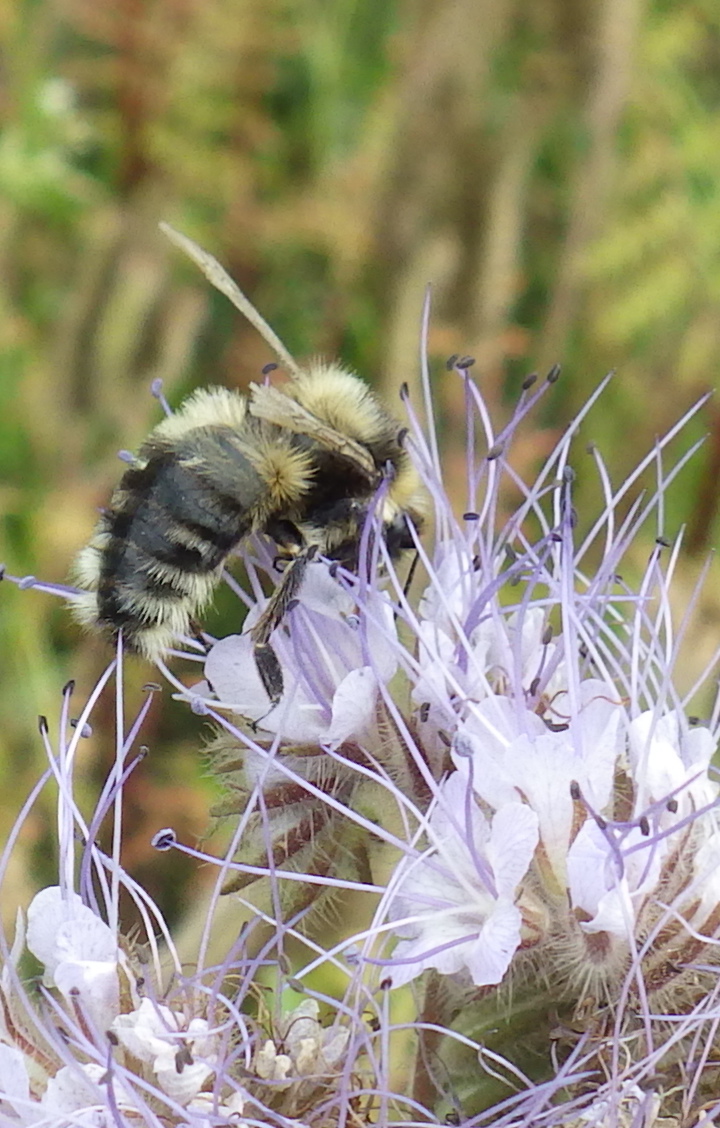

Since the hair is worn off its abdomen, identification is even more difficult than usual, but I will do some detective work.


It was quite a large bumblebee--queen-sized in fact.


As you can see, its wings are quite worn and it has yellow or buff hairs at the top of its head and a handsome black tache.


The farm has been a recipient of grants from the TD Friends of the Environment Foundation to grow bee forage on the farm. This field of phacelia bordered by clover and mustard is a direct result of that funding under the leadership of Leslie Williams.


While I wandered around the edges of the meadow, a photographer had his wife wade into the flowers so he could take the classic "beautiful women in flowers" shot. One of the farmers had suggested he mow a U-shaped path in the meadow for folks to wander through. Paths are good, but most of the action happens around the edges of the field anyway. And less paths means more flowers for the bees.


This eastern bumblebee is having a rest after gathering pollen from another plant. The pollen from this phacelia is actually dark purple.


This is what I think is the female of that mystery Bombus above. She is lovely!


Having this field of phacelia on the farm boosts the number and variety of bees on the site. Dr. Gordon Frankie has counted 56 species of bees on this species of phacelia in California. You can check out a nice interview with him here.


Thanks to Leslie Williams, the instigator of this project, for demonstrating what a beautiful meadow can do for our bees. This is a great model for Richmond because it creates a good habitat synergy in the zones between farming sites and wild habitat. Meadows help feed the farmed pollinators and the wild bees. More meadows please!

Thursday, July 26, 2012

The Bees in the World in a Garden


 I had a lovely time leading a workshop at The Passport to Permaculture Camp at World in a Garden. We talked about the biodiversity of bees, made bee habitats for native bees and left messages for the honeybees.


The kids wore gloves to handle the bamboo as it does tend to give slivers.


It's good to work in three dimensions to get the brain working creatively.


 This dude put his bee habitat on his hat. Hmmmm, he thinks the same way I do. Maybe he's a budding performance artist?


 I knew the beekeeper was coming in the afternoon to open the hive, so we made messages for the bees and I took the students a few at a time to get as close to the hive as they felt comfortable doing.


 We tried to pet a sleepy bumble bee and he crawled up on a girl's finger. The look on her face was delight mixed with surprise. And it didn't sting!


 It was a perfect day for honeybee activity.


 When the kids started snacking on raspberries and other things in the garden we decided it was snack break time. The kids generously shared their kale chips with me. They were delicious! The secret was they were covered in Little Creek salad dressing (my fave) and dehydrated. Wow.


 California poppies are perfect for spotting bumble bees.


 Doesn't this kohlrabi look delicious? You have a chance to buy food from the garden this Friday from 3-5 pm when the kids set up their own market stall.


I hope there's gonna be kale chips!

Friday, April 15, 2011

A Child of Nature

It is so satisfying to work with students who are enthusiastic and appreciative. I love that this boy was completely engaged in my workshop and decided to take it to a different level, sketching his designs from the daffodils in the garden outside his classroom.


I like to see students who become immersed in the tactile sensation of paint and who are proud of their work. Some are hummingbirds, quickly finishing any task you set before them. Others are more meditative, spending an hour on each step, fully immersing themselves in the process.

I heard an award-winning teacher speak on CBC this Sunday. He said to be a good teacher you have to have a sense of gravitas about important subjects, you have to care for the students and you have to cultivate a flair for the dramatic. He also stressed the need to know your subject inside out.

One of the reasons I love teaching is the chance to explore new materials and subject matter. This was the first time I worked with gourds. It took about five months to dry them. I spent a weekend painting them with a base coat, coating the inside with beeswax, and punching holes for string.

It's a good introduction to bird feeding to make this craft. We also made pine cone feeders as well. These are usually made in winter when suet pudding is in season, but luckily my butcher had one bag of suet left in the back of his freezer. You can buy suet in bird stores, but it is almost always mixed with nuts, which cannot be used in schools because of allergies.

I used sunflower butter I made from shelled broken sunflower seeds I bought at the bird seed store mixed with sunflower oil. The students loved pouring the millet seeds over the pine cones.

We made a huge mess as usual. (I owe the custodian a bag of his favorite coffee to stay in his good books!)

If you feed the birds while they are nesting in the area they can spend more time on the nest and defend their chicks against those hungry crows.

Saturday, July 25, 2009

Retribution

Working on the bee garden has been a boon to me. Since it has been hot and dry I must water it thoroughly twice a week, hauling the hose out, patiently waiting to move it from one sunflower to the next. It's a great way to have a physical relationship with a garden. Today I saw a lady bug larva on a sunflower petal, but of course by the time I retrieved my camera it had disappeared. I saw a few leaf-cutter bees today too, in the sunflowers and perennial sweet peas. Most times watering the garden nurtures my soul, but today I was very upset by what I discovered. Someone pulled out all the calendula grown from seed and put it on the compost pile. I'm pretty sure I know who did it, at least I have a prime suspect. He is angry, rancorous, possessive, and he wanted to send me a message. I don't really know him, but he lives in the neighbourhood and he doesn't think I should be able to have permission to grow this garden because I don't live as close to the garden as he and his friends do. The flowers had been pulled out by the roots and were still fresh, so this cowardly act was done this morning before I came to the garden. (There is a story behind this story which involves well-meaning gardeners, a misunderstanding, and a death in the community.)

Obviously this person is suffering from some personal trauma. He frightens me, but at the same time, what I know is he (or she) needs healing, redemption, or a good kick in the a--. The bee garden is meant to be a healing garden, and perhaps it is functioning as such, but not in the way I imagined it would. A memorial garden for a deceased neighbour was completely destroyed as well, so what worries me is that this destructive bent will continue until the perp gets a reaction from me. He wants me to get angry at him because he feels empowered by conflict. Peace leaves him feeling impotent. Yes, these are the people in our neighbourhoods.

This experience just reminds me again how transient gardening is. Like a mandala that is painstakingly prepared and then swept up every season, it's here today and gone tomorrow. By gardening in a public space, I have become emotionally involved with a community that is dying to garden. Everyone wants their bit of soil to lay down roots, to connect to the life-force of the planet itself. I feel the desperation, not just from one person, but from apartment buildings full of people: men, women, and children. Some days it's too much for me to handle. Sigh.

' In the meantime, here are some photos of what's blooming now and the garden.


Behold, Sunzilla!

A leafcutter bee with an abdomen covered in bright yellow pollen.

Russian Sage, or Perovskia. We saw this planted in roadside gardens in the Okanagan, where it does well in the dry climate.

EYA apprentice beekeepers inspect the hive with instructor Brian Campbell.


Mint wins the prize for being the plant most busy with busy today.