It seems there is more and more coverage of native bees in the news these days. Check out these amazing photographs in an article called Beyond Black and Yellow: The Stunning Colors of America's Native Bees. Sadly the bees are all pinned, ie dead, but they are incredibly detailed photographs.
Thanks to all who came out to the Hummingbird Garden Party. I had a good time in spite of the Bouncy Castle (!). There was a noisy generator parked right by the garden, but the bees didn't seem to mind. I had a sighting of one of those beautiful turquoise sweat bees while I was doing a garden talk. She was on an echinacea flower, but I just caught a quick look at her hind end and her back legs were fat with a light lemon-colored pollen.

Monday, August 12, 2013

Sunday, August 11, 2013
Hummingbird garden Party will Go Today Rain or Shine!
Even with a thunderstorm predicted with afternoon we can still have our garden party, even if it is under the cozy cover of the Mobery Community Centre! Please join us whatever the skies provide!
I spent last night sewing the finishing touches on my costume. Don't forget to wear red!
I spent last night sewing the finishing touches on my costume. Don't forget to wear red!
Join at us the Moberly Cultural Herb Garden for a garden party celebrating the healing power of plants and gardens.
There will be tea and treats and garden tours with Madame Beespeaker.
Erin Udal from the Environmental Youth Alliance will discuss the programs the EYA have been creating to help the bees in our city and how you can help.
Herbalist Lori Snyder will talk about local herbs you can find to boost your health. Some of the medicines you need might be the ones right under your feet!
Meet the new Moberly artist in residence
Melanie Schambach and artist/gardener Holly Schmidt.
Where:
Behind the Moberly Community Arts Centre, 7646 Prince Albert Street,
one block east of Fraser and 60th
When:
Sunday August 11, 2-4 pm.
Dress-up
Theme: Dress like a hummingbird flower: wear red!!!!!!!
FREE
and all ages are welcome.
Friday, August 9, 2013
More BUM in your Garden Equals More Bees: Brassicas, Umbels, Mints

After finishing up my fifth and final citizen scientist survey counting bees in Mount Pleasant Park and Community Garden, I have some insights about the common garden cultivars that bees love. First of all morphology, or the way flowers are shaped is very important. If you imagine flowers to tiny cups for bees, you start to see which cups bees prefer. Bees love the simple cross-shaped blossoms of brassicas, the tiny cups of umbels, and the miniature bilaterally symmetrical blooms of mint. The nectar rewards from three kinds of plants can attract all sizes of native bees and honey bees.
Also, note the spearlike shape of the spearmint infloresence. This cone-shaped collection of florets is often attractive to bees.

Pollen rewards are also important. As you can see here, this bumble bee has a big wodge of ivory or grey pollen on its hind legs. Pollen and nectar also contain the chemical constituents of the plant which affect it odor, flavor, and medicinal properties.

You can see here in these fennel florets that they are shaped like tiny cups. Fennel pollen grains are quite large, turning the legs of this tiny pollen pants bee quite yellow, which is why I thought she was a wasp when I saw her first.

But you can see here she does have quite a fuzzy head and thorax.

This plant is a new bee plant I'm growing for the first time in my back yard. It is a cultivar of Angelica Sylvestris called 'Vicar's Mead.' I couldn't pass up a plant with a name like that! This past week it has been very popular with all sorts of bees. I asked a blogger named Marc Carlton from England about this plant since it was on his website and he kindly explained that this is a purple cultivar from a native British plant that is normally green. I highly recommend his website www.foxleas.com. It has excellent information on gardening for bees and Carlton is an inspiring and lyrical writer. He has real experience of watching bees in his garden to see which plants are active. I love this quote from an article called "How to choose plants that support pollinators: creating a new paradigm for 'native'":
"My pollinator border is a “terrestrial coral reef”, not only a mass of disparate shapes and colours, but alive with the movement of small creatures – but insects, not fish."
--Marc Carlton, www.foxleas.com
I have been thinking about that quote all summer and it has inspired me in ways I will share with you soon.

I wonder if this little bee is collecting pollen here or from the adjacent fennel plant.

My fennel is absolutely noisy with bees of all sizes. Then the shade hits the plant at dinner time and it falls silent. Bees go home to bed. They fly toward the Nasanov signals that their hive mates are using to call them back to the hive. The chemical constituents in the Nasanov perfume are some of the same that attract bees to flowers.
There's the phenology of blooms that affects whether bees will feed from them and also a floral clock of sorts. Bees seem to have an innate preference for certain types of flowers over others, but their choice is also determined by proximity to their home base, especially at night when they are topping up before they go home. I see hummingbirds heading for specific plants for a long feed: ie monarda, buddleia, and crocosmia, and then they top up with other various plants in the proximity before they head home. They seem to know how much food they'll need before they head home and try to make it through the night on the food they've consumed.
Some plants have long bloom periods, but short nectar runs. It seems the same way with pollen, which is why this week I've finally seen bees on yarrow and marigolds, even though they have been blooming for months.

And on a completely different note my monarda is blooming! Can't you see this as part of a Hummingbird coral reef!
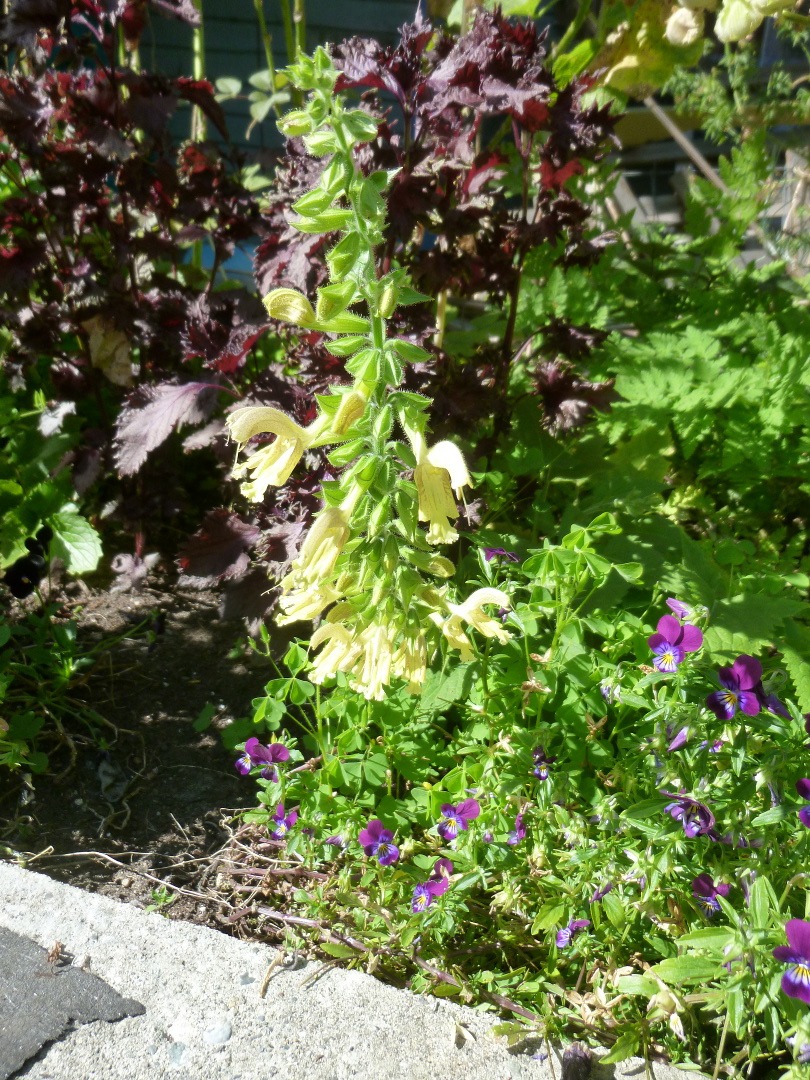
As is this wacky salvia which the tag told me was supposed to have blue flowers. Oh well. It's pretty amazing. And a reminder that many sages are also great bee and or hummingbird plants. Like mint, they have bilaterial blossoms. The salvia with larger longer nectaries suit hummingbirds and the smaller blooms suit bees.
Thursday, August 8, 2013
Skippers and a New Insect Hotel

I have been noticing a lot of skippers lately all around the city. They are so plucky and playful. I like their attitude. This is a skipper in the snowberry (still blooming!!!) at the Moberly Cultural Herb Garden. (Have you got your red dress for the party this Sunday????)

This is a small buddleia at the Oak Meadows park. It is a shame that most buddleia are invasive* here in Vancouver because they are great bee, butterfly and hummingbird plants. In fact, after I took this picture, I stood up and startled a hummingbird feeding from this plant. This afternoon I spent a good ten minutes watching an Anna's female feed in my neighbor's towering 18 ft buddleia. The bees were all over it as well. The Anna's even fought with a smaller hummer (perhaps a female rufous) to defend "her" bush. There was no squeaking, just the clacking of beaks like tiny swords. About a half and hour later there was a flock of bush tits in the buddleia, feeding on bugs. It was funny to see them land on a branch and sproing up and down on it.

You can see her tongue go into the orange center of the floret.

Erin Udal from the Environmental Youth Alliance says the yarrow in Oak Meadows Park has bee supporting the bees since the lupins finished. We discussed how plants like yarrow can be empty in some gardens and teeming with insects in others.

There are a variety of wasps out now and bees that look like wasps, so it all gets very confusing. But this wasp is acting like a bee.


These twins love phacelia.

This is an empty ladybug pupae case on tansy, which is an escaped old world herb. The honey bees and bumble bees were visiting this plant as well.

Check out this fabulous new insect hotel made from a decommissioned phone booth by Contexture Design!
*You must cut off the seed heads of the buddleia before they mature. Plant breeders are developing less fertile cultivars, but the pollen and nectar rewards may not be the same as the weedy ones. We have one that grows out of a crack in the sidewalk in front of our house.
Friday, August 2, 2013
Rain and Relaxation, and Tapestry for the Senses

It is raining outside as I write this cozied up in my writing cave and I am so happy I could cry. I am exhausted. I have been watering 6 gardens this month and bloody heck, I need a rest! Besides which, there are corners of the back yard where my hose will not reach and they are desperate for moisture. Hallelujah! I have also been taking photos of bees and hummingbirds almost every day this month. I have hundreds of images to sift and sort. My work is cut out for me.
It has been an amazing month of investigation, meditation and revelation for me. Now I have to sit and write it all out. There is an imaginary crocheted scarf forming in my head and then there's the scarf that I am actually crocheting. Every day I add a few loops and piece together a narrative out of my experiences over the last six years. This month has been very symbolic for me--returning home to Saskatchewan to loop back the beginning to where I have worked my way to the Pacific Northwest, doggedly trying to connect myself to its social and ecological fabric.
I have created a home with my family, colleagues and friends. Our garden in the heart of the home. It's such a pleasure to be able to sit in the garden and watch the bees in the flowers as we did last night after dinner. And before the day is over I just have to squeeze in one more bee photo: a little sweat bee hunkering down for the evening on a pale pink sweet pea blossom. Are those little bite marks on the petals? Is she literally hanging on by her teeth? (Or mandibles in this case.)
It's raining, so the bee activity will slow down, but I still have work to do. Please join Rebecca Graham and I tomorrow, August 3 at the Roundhouse Turn Table from noon to 2 pm for some fun with bee and hummingbird plants.
Tapestry for the Senses
Join artists Madame Beespeaker and Rebecca Graham in creating a multi-sensory, multi-dimensional tapestry exploring the healing powers of bees and hummingbirds. Using a seasonal palette of herbs, plants, flowers and other natural materials, we'll create pathways and panels to appeal to the eyes, nose and fingertips, while discovering how the world appears to the senses of bees and hummingbirds.
You are Invited to a Hummingbird Garden Party!

Join at us the Moberly Cultural Herb Garden for a garden party celebrating the healing power of plants and gardens.
There will be tea and treats and garden tours with Madame Beespeaker.
Erin Udal from the Environmental Youth Alliance will discuss the programs the EYA have been creating to help the bees in our city and how you can help.
Herbalist Lori Snyder will talk about local herbs you can find to boost your health. Some of the medicines you need might be the ones right under your feet!
Meet the new Moberly artist in residence
Melanie Schambach and artist/gardener Holly Schmidt.
Where:
Behind the Moberly Community Arts Centre, 7646 Prince Albert Street,
one block east of Fraser and 60th
When:
Sunday August 11, 2-4 pm.
Dress-up
Theme: Dress like a hummingbird flower: wear red!!!!!!!
FREE
and all ages are welcome.
Hummingbird Flowers are on Fire!
 |
| Perfectly behaved and neatly coifed zinnias waiting for hummingbird visitors |
This spring I purchased seeds for plants that were supposed to attract hummingbirds. I have planted them in four different gardens around the city. It's the beginning of August and many of them are now in full bloom. I was sitting in my back yard moping about having spent all this time and energy and no hummers were visiting the flowers. Just at that moment, a sweet female Anna's came and fed at the Cardinal Creeper. I was so excited. But what made my heart burst, was when her male partner joined her and they both fed in the garden. Now they are returning every day.
 |
| Sweet peas in lipstick shades |
They were really into those Cardinal Creepers, but they did sip at the red sweet peas and I saw one stick her beak in a California poppy that had closed for the night. Hummingbirds seem to like to travel at dusk to fill up for the long night, so the morning glories are finished, but they were still trying to get nectar out of the blossoms. Hummingbirds don't have a sense of smell, so the intense fragrance of the sweet peas is lost on them, but I have been enjoying their sweet smell of summer.

You can see why they are attracted to the cardinal climber blossoms. They are classic red trumpet-shaped flowers. I would say these and the red monardas are the flowers that really draw the hummingbirds in and then they tend to sample other plants around these ones.

I thought these morning glories were supposed to be red, but they are next to a pink rose, so I don't mind so much. Please note, these are not invasive like the white morning glories that are a pest in this province. I've planted them in pots as I try to get a handle on the goutweed in this section of the garden.

Along with my anise hyssop for bees, I have planted these varieties of agastache (hummingbird mint) which have the longer blossoms for the hummers.

These fragrant agastache come in shades of pink and orange.

This is Cleome spinosa, and I am curios to see how the birds feed at these wacky flowers.

This is hummingbird salvia. I also planted some of the salvias with the bright blue blossoms, but they have finished blooming.


One of the hummingbird salvias has white blooms, which I believe is a mutation or a throw back to its wild origins. I'll have to save the seed and see if I can cultivate more of these.

I'm always happy to see these skippers in the garden!

I visited Banyen Books yesterday and realized that the garden along their east side contains cool hummingbird plants. I don't know what these plants with the creamy yellow blossoms, but they would suit hummers.

This is a jasmine that can overwinter in Vancouver.

This is orange trumpet creeper vine, aka Campsis radicans. Native to the Southern US, they come with a big invasive warning. The roots can damage property and you should collect the seeds before they fall to the ground.

Finally, the bergamot next to the street is finishing up. The scavenger in me wanted to collect and dry all those lovely red blossoms.

This is monarda at the City Hall community garden. The hummingbirds perch in nearby trees and then swoop down to feed when the coast is clear. If you want hummingbirds in your garden, this plant is a true "hummingbird magnet" along with fuschias, red-flowering currant, honeysuckle and crocosmia. If you plant it, they will come!
Subscribe to:
Posts (Atom)