Saturday, March 31, 2018

The Bee and Butterfly Festival in Centre Valley, California


"You're going to California!" my friend exclaims. "What for?"
"A pollinator festival", I reply.
"Is that a thing? she asks.
"Yes it is, or is should be a thing." I say.

What does a pollinator festival look like? Well, it can take as many forms as there are venues, so I wanted to share images from the Bee and Butterfly Festival created by the library in Center Valley California. First of all, you need a leader, someone who has vision, creativity, energy and a huge heart. Laura Zuckerman, the library's director was the festival's leader and motivator.


Crafts! A pollinator festival needs drop-in family friendly crafts that are also eco-friendly. Loretta works with the youth at the library and she graciously drove me around to the schools where I worked with budding farmers and potential bee gardeners.


Costumes! You can't have a festival without pollinator costumes. Keep a stock of them on hand for the special occasion.


 Crafty beekeepers!


Local gardening support! The Master Gardeners created a beautiful display and shared helpful gardening tips and resources.


And of course giving away and/or selling seeds and plants is one of the most important parts of a pollinator festival. Bees gotta eat and you need to plant something for them to tuck into. In California that means planting bee plants that bloom all year round!!!!!


Getting a local lavender farm involved is also a bonus, especially when it is a lovely ORGANIC farm tucked away in the hills with a pool and luxury glamping tents. You should go!


Food trucks are a fantastic addition to a pollinator festival. (The scones were especially delicious.)


And in SoCal, there's gonna be honey. The dark, rich winter honey infused by All Natural Soaps comes from eucalyptus and avocado trees.


Many of the beekeepers are also displaying mason bee homes. Haven't you heard? Bee hotels are the new bird houses! The more beekeepers learn about native bees, the better they will understand the impact that keeping non-native bees has on their local bee population.


I had some fantastic conversations with Tracy Ellis, an ag scientist for the County of San Diego  and Leah Taylor from the UC San Diego--lots of food for thought.


It's great to have a load of local specimens so folks can see the amazing biodiversity of insects in the local flora.


And beeeeeeeees!!!!! Ya gotta have bees! Many of these specimens were collected by an awesome bee scientist named James Hung. Check out his website here!

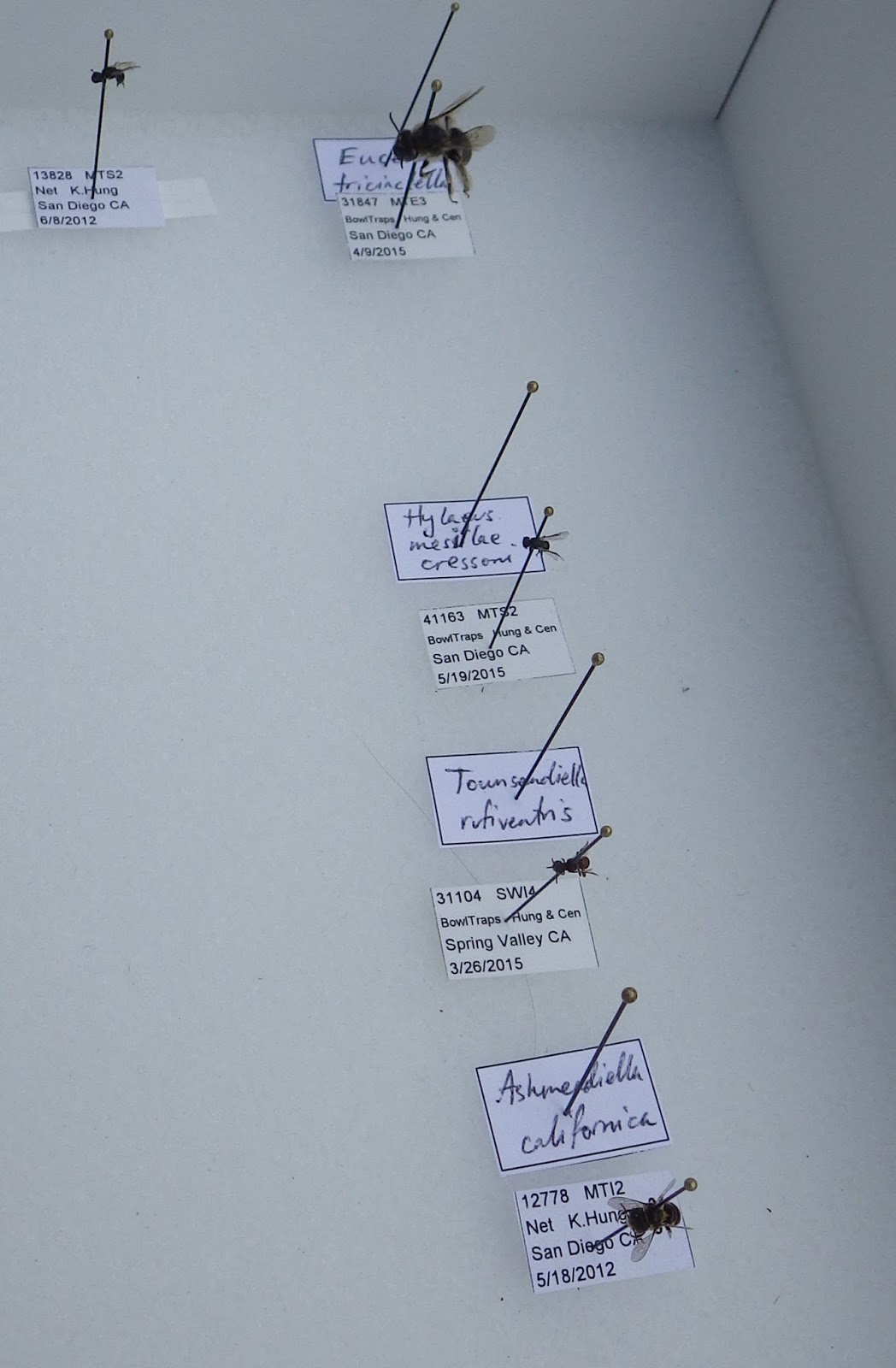


This is also amazing--having the plant specimen surrounded by the associated insect visitors.


Did you know there's a water bug called a toe biter? Yikes!


I was really hoping to see a live large carpenter bee (Xylocopa).  However this specimen, shown by Annika Nabors, was as close as I came to one!


 What a great idea for the face painting station! Point at the picture and you get what you asked for.


Quizzes! There was also a festival passport which children got stamped at every station to receive a prize.


The local ecologists had a lovely table. (Note the mug on the left--the hermit of hellhole canyon--mythical or real dude?)


The Master Gardeners also had a fantastic butterfly gardening display.


 Duuuude! That's who's wearing the mysterious bee costume.


And introducing Carlotta the Cuckoo Bumble Bee!


There's also a nature trail with signage just adjacent to the library.


And this is where I was able to take a photo of a sweet little native bee, ending the festival on a personal high! Thanks to everyone who made this event possible. Long live the Valley Bees!

For those people who want more fantastic resources for gardening for bees in California I have three additional book recommendations (aside from my book Victory Gardens for Bees):


 California Bees and Blooms: A Guide for Gardeners and Naturalist by Gordon W. Frankie, Robbin W. Thorp, Rollin E. Coville, and Barbara Ertter


Sunday, March 18, 2018

Calgary Seedy Saturday 2018


A  big thanks for all the great support and conversations at Seedy Saturday!

Here are some links I promised to post:

How to make houses for NATIVE bees: http://www.xerces.org/wp-content/uploads/2008/11/nests_for_native_bees_fact_sheet_xerces_society.pdf

How to make a bumblebee box: https://www.youtube.com/watch?v=DYKAvRsS3uo

Two places to submit your photos of bumblebees so scientists can track their populations:

1) Bumblebee Watch: https://www.bumblebeewatch.org/
2) Great Canadian Bumblebee Count: http://foecanada.org/en/issues/bumble-bee-count/


Monday, February 26, 2018

Gardening for Our Lives: How to Create Corridors of Resilience


Join Madame Beespeaker for a garden talk at the Renfrew Park Library
 in east Vancouver on Sunday, March 4, 1:30 pm.


As we lose more and more arable land and wild habitat to development and industrial agricultural, we need to build corridors of resistance, with plants that provide food for wildlife and humans. Lori will discuss how we can pull together to create this edible infrastructure, and defend these pollinator pathways that help preserve the biodiversity that is being lost every day on this planet. Lori will talk about ten tough plants we need to propagate in Vancouver to help boost our chances of keeping Metro Vancouver healthy and green.

This talk is a part of the Super Bloomers artists in community residency at Renfrew Park Community Centre.

Do you like to take photos of flowers? Why not try to capture bumblebees on the flowers in your garden? Find out how you can be a citizen scientist this summer with The Great Canadian Bumblebee Count.


Wednesday, November 1, 2017

Saskatchewan Bumblebees Species List


I had a fabulous time hanging out with the members of the Saskatchewan Perennial Society in Saskatoon. It was an inspiring experience, and has got me all fired up about protecting our beloved prairie bees. There is a surprising number of bumblebee species in Saskatchewan, with different species found in the different bioregions. For details on where the species have been found, be sure to check out Philip S. Curry’s book: Bumblebees of Saskatchewan (Hymenoptera: Apidae) a survey of their geographic distribution. May thanks to Philip and Cory Sheffield for helping me compile a list of Saskatchewan bumblebee species to date. (Any errors are my own!)
There are 26 species of bumblebees in Saskatchewan. Four are cuckoo bees that parasitize the nests of true bumblebees. Four of the true bumblebees are long-tongued with tongues longer that that of the honeybee tongue, which is about 7 mm in length. Five species of the bumblebees are short-tongued with tongues less that 7 mm long.
Long-tongued bees will favor flowers with long corollas in your garden, such as Mondarda fistulosa, the bee balm that is native to Saskatchewan. Plant lots of it!!!!! Add in some other fabulous Monarda species for your best edible bee-feeding bouquets. The medium-tongued bees will feed on your Echinacea purpurea and dip into the flowers with deeper nectaries if they are full to the brim, using the capillary action of their tongue to lap up the sweet stuff. The larger-bodied bumblebees and the queens also like Echinicea purpurea because the flowers can support their weight. The smaller-tongued bees will chew holes in the wild bee balm and rob the nectar without pollinating the flower and they will dip into the smaller flowers and all the asters (gaillardia, grindelia, goldenrod, sunflowers, etc.) with their tiny florets. The rare Bombus occidentalis, which has a short tongue loves the pincushion flower (Scabiosa atropurpurea).  So have fun creating biodiversity in your prairie garden to make it hum with choirs of bumblebees!

Saskatchewan Bombus (Alphabetical Order)

1: White-Shouldered Bumble Bee (Bombus appositus)
Subgenus: Subterraneobombus (long-tongued)
2: Two Form Bumblebee aka Black-notched Bumblebee (Bombus bifarius)
Subgenus Pyrobombus (medium-tongued)
3: Gypsy Cuckoo Bumble Bee (Bombus bohemicus) includes Ashton’s Cuckoo Bumble Bee (Bombus ashtoni) --Endangered
Subgenus Psithyrus
4: Northern Amber Bumble Bee (Bombus borealis)
Subgenus: Subterraneobombus
5: Central Bumble Bee (Bombus centralis)
Subgenus Pyrobombus (long-tongued)
6: Fernald’s Cuckoo Bee (used to be Bombus fernaldae now B flavidus)
Subgenus: Psithyrus
7: Yellow-fronted Bumble Bee (Bombus flavifrons)
Subgenus: Pyrobombus (medium-tongued)
8: Golden Northern Bumble Bee (Bombus fervidus) (including B. californicus)
Subgenus: Thoracobombus (long-tongued)
9: Frigid Bumble Bee (Bombus frigidus)
Subgenus Pyrobombus (medium-tongued)
10: Brown-belted Bumble Bee (Bombus griseocollis)
Subgenus: Cullumanobombus (medium-tongued)
11: Hunt's Bumble Bee (Bombus huntii)
Subgenus: Pyrobombus (medium-tongued)
12: Indiscriminate Bumble Bee (Bombus insularis)
Subgenus Psithyrus
13: Heath Bumblebee (Bombus jonellus)
Subgenus Pyrobombus (short-tongued)
14: Black Tail Bumble Bee (Bombus melanopygus) aka red-rumped
Subgenus: Pyrobombus (medium-tongued)
15: Fuzzy-Horned Bumble Bee (Bombus mixtus)
Subgenus: Pyrobombus (medium-tongued)
16: Nevada Bumble Bee (Bombus nevadensis)
Subgenus: Bombias (long-tongued)
17: Western Bumble Bee (Bombus occidentalis occidentalis)--Threatened
Subgenus: Bombus (short-tongued)
18: Confusing Bumble Bee (Bombus perplexus)
Subgenus: Pyrobombus (short-tongued)
19: Red-belted Bumble Bee (Bombus rufocinctus)
Subgenus Cullumanobombus (short-tongued)
20: Sanderson's Bumble Bee (Bombus sandersoni)
Subgenus: Pyrobombus (medium-tongued*) IUCN*
21: Sitka Bumble Bee (Bombus sitkensis)
Subgenus: Pyrobombus (medium-tongued)
22: Suckley's Bumble Bee (Bombus suckleyi)
Subgenus Psithyrus
23: Red-tailed Bumble Bee (Bombus sylvicola)
Subgenus: Pyrobombus (medium-tongued)
25: Special Concern--Yellow-banded Bumble Bee (Bombus terricola)
Subgenus: Bombus (short-tongued)
26: Half-black Bumble Bee (Bombus vagans vagans)
Subgenus: Pyrobombus (medium-tongued)

Sources:
Cory Sheffield
 Bumblebees of Saskatchewan (Hymenoptera: Apidae) a survey of their geographic distribution by Philip S. Curry, 1984.
Discover Life (www.discoverlife.org)
Saskatchewan Conservation Data Centre (http://www.biodiversity.sk.ca) a survey of their geographic distribution.
Bumble Bees of North America: An Identification Guide by Paul H. Williams, Robbin W. Thorp, Leif L. Richardson, Sheila R. Colla, March 23, 2014 Princeton University Press.