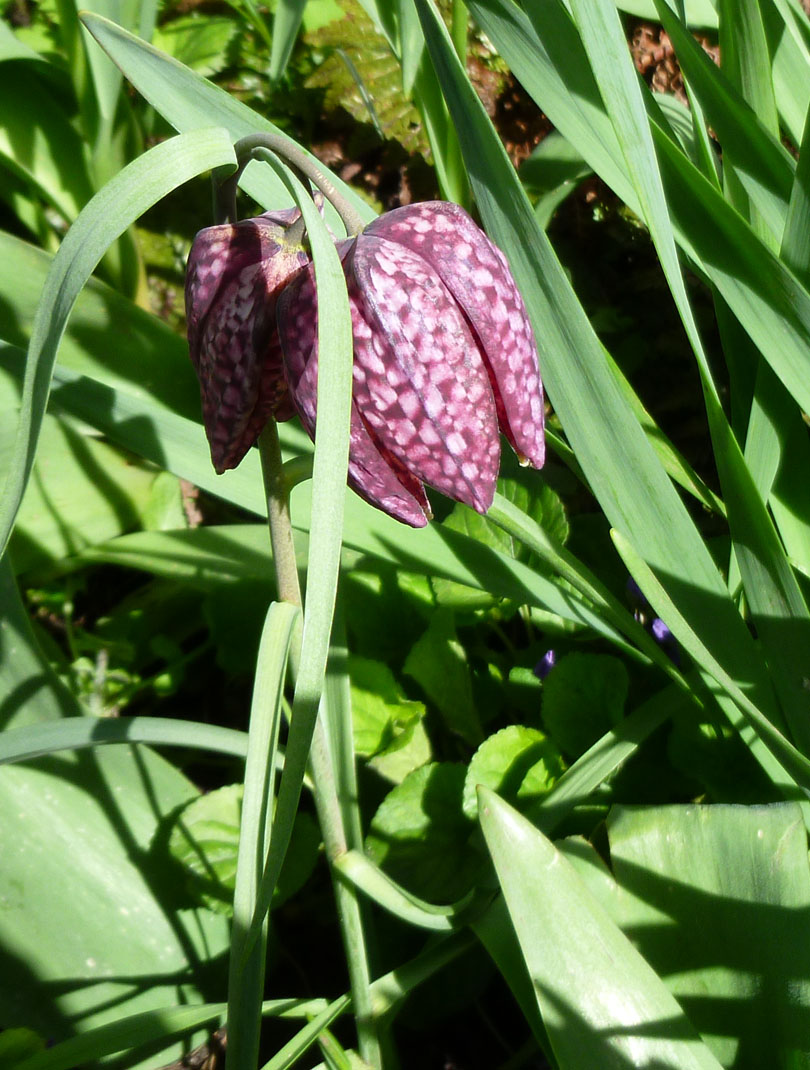
 This is one of my favorite flowers. I hope they are all right now that the weather has been dipping into almost freezing temperatures.

Friday, April 15, 2011
Checkered Lilies Blooming in April
This is one of my favorite flowers. I hope they are all right now that the weather has been dipping into almost freezing temperatures.

A Child of Nature
 It is so satisfying to work with students who are enthusiastic and appreciative. I love that this boy was completely engaged in my workshop and decided to take it to a different level, sketching his designs from the daffodils in the garden outside his classroom.

 I like to see students who become immersed in the tactile sensation of paint and who are proud of their work. Some are hummingbirds, quickly finishing any task you set before them. Others are more meditative, spending an hour on each step, fully immersing themselves in the process.
 I heard an award-winning teacher speak on CBC this Sunday. He said to be a good teacher you have to have a sense of gravitas about important subjects, you have to care for the students and you have to cultivate a flair for the dramatic. He also stressed the need to know your subject inside out.
 One of the reasons I love teaching is the chance to explore new materials and subject matter. This was the first time I worked with gourds. It took about five months to dry them. I spent a weekend painting them with a base coat, coating the inside with beeswax, and punching holes for string.
 It's a good introduction to bird feeding to make this craft. We also made pine cone feeders as well. These are usually made in winter when suet pudding is in season, but luckily my butcher had one bag of suet left in the back of his freezer. You can buy suet in bird stores, but it is almost always mixed with nuts, which cannot be used in schools because of allergies.
 I used sunflower butter I made from shelled broken sunflower seeds I bought at the bird seed store mixed with sunflower oil. The students loved pouring the millet seeds over the pine cones.
 We made a huge mess as usual. (I owe the custodian a bag of his favorite coffee to stay in his good books!)
 If you feed the birds while they are nesting in the area they can spend more time on the nest and defend their chicks against those hungry crows.
Tuesday, April 12, 2011
Omelette Fines Hops
 I had to fix a quick lunch between teaching gigs and I had some nettles in the fridge from the winter market. I also had spied some hops sprouts peaking up like asparagus under the hydrangea. So I made a spring omelette. I steamed the nettles, handling them with yellow kitchen gloves and I quickly sauteed the hops tips with a bit of garlic. I only used the tips because there's some bejeezley big prickles on the lower part of the stems. What to drink? Rhubarb juice with sparkling water.
Please note that due to the Vasakhi Parade, this seed ball workshop has been moved to Saturday May 7:
Herbal Seed Balls for Pollinators
10:00am-12:00pm
Lori Weidenhammer
Seed balls originate from an ancient form of agriculture
performed by creating balls of seeds, clay, and compost
and sowing them on the surface of the soil. The seeds
remain dormant until environmental conditions allow them
to germinate and flourish, creating nectar and pollen-rich
habitat for pollinators. In this workshop we will be creating
seed balls for spring planting. This workshop is suitable
for families. (Children under 5 must be accompanied by a
caregiver.) FREE! In the LOBBY at Sunset Community
Centre
Friday, April 8, 2011
Buddies for Buddies and Buddies for Bees
 Today I worked with a grade 4/5 class and their buddies in kindergarten. One of my favorite things about this school is their mentorship program and it works really well with art projects.
 The older students helped the k's paint a rock for bees to rest and sun themselves. (Painted rocks should not rest in water.) Then they painted the outside of a terracotta dish (leaving the inside unpainted!) and filled it with sand and pretty rocks. You can place this "bee oasis" in your garden and keep moist with the rocks above the water level so the bees can land on the rocks to take a drink. Don't use too much water or you will be growing mosquitoes! (I learned this trick from my friend Brian Campbell.) You can use water without sand, but then you need to change it every day. It would be a good idea to take the terracotta bee oasis inside during the winter so it doesn't freeze and break.
 The students created designs inspired by floral designs and bees. It's lovely to see the sense of compassion the older kids develop for their buddies.


Wednesday, April 6, 2011
Eating Mason Bees

No, it's not the latest foodie craze. It's a dream I had. Yes, I dreamt that some mason bee guru told me that you had to eat the cocoons so they could hatch and so I ate them like vitamin pills. It was very strange. What does it all mean? It means I have been reading about mason bees from dawn to dusk. I also have a feeling in my bones that the males are gonna come out this weekend. Now that the sun is out, masses of cherry trees and Pieris Japonica (see above) are blooming, it's time to see some mason bees! I've got some cocoons in my fridge that I might put out this weekend, depending on the long range forecast. In the meantime, I'm going to be hosting a mason bee charette with a grade 6 class. Each group of students will design the ultimate mason bee condo. Here are the criteria. Why not try it yourself and let me know how it goes?
Criteria:
1) Waterproof, weatherproof and sheltered from the elements (ie cold winds, snow)
2) Keeps cocoons safe from large predators: skunks, raccoons, woodpeckers
3) Keeps cocoons safe from tiny predators: mites and parasitic wasps
4) Has a way to be attached to the (south)east side of a building or architectural structure.
5) Has a way for bees to orient themselves to their home hole so they don't end up in a fight.
6) Allows the cocoons to breathe in wet weather and not get mouldy.
7) Opens up so that it can be cleaned and sanitized in November and easily reassembled for the spring.
8) The tunnels are made with a material that the bees have traction to navigate and turn inside the tubes without slipping.
9) The materials are ecologically sound and safe for the bees.
Bonus points for:
1) A safe compartment for cleaned cocoons
2) A predator guard
3) A really cool name
4) A really cool sign
5) A visible home so that you can monitor the bees at work
6) A way you can modify the home for summer mason bees and/or leaf cutter bees
Tuesday, April 5, 2011
More Work for the Birds
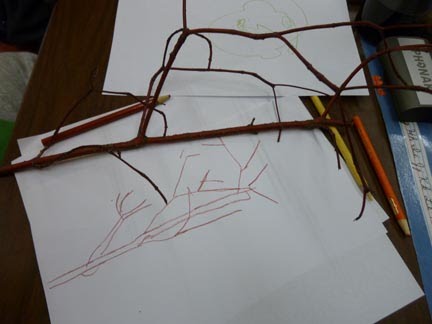
 I have started a residency at an elementary school. We are exploring ideas on habitat and how to attract birds and insects to your school and back yard. Yesterday we made woven forms to present nesting material to the birds.
 The students also made some lovely drawings. It's a very talented class and it was a pleasure to work with them. I also talked to the students about Bower Birds and they drew images of objects that would attract them to a human oriented bower. (I suggested chocolate, of course.) What did they come up with? Lots of flat screen televisions and cold, hard cash!



Saturday, April 2, 2011
Starting Seeds
I am at the Sunset Community Centre on Main Street today propagating seeds with Aimee Taylor. Please drop in if you are in the hood and also on April 16 when I'll be making seed balls.
Seed Starting Saturday, April 2 10:00am-12:00pm
Instructors: Aimee Taylor & Lori Weidenhammer
A free workshop-open to all! Learn how to create the
best starting environment for your seeds. Supplies will
be provided to start your vegetable and herb garden off in
the spring. Held in the lobby at Sunset Community Centre
Herbal Seed Balls for Pollinators Saturday April 16 10:00am-12:00pm
Lori Weidenhammer
Seed balls originate from an ancient form of agriculture
performed by creating balls of seeds, clay, and compost
and sowing them on the surface of the soil. The seeds
remain dormant until environmental conditions allow them
to germinate and flourish, creating nectar and pollen-rich
habitat for pollinators. In this workshop we will be creating
seed balls for spring planting. This workshop is suitable
for families. (Children under 5 must be accompanied by a
caregiver.) FREE! In the LOBBY at Sunset Community
Centre
Subscribe to:
Posts (Atom)