Showing posts with label bumblebees. Show all posts

Thursday, March 23, 2017

A Mixed Bag of Bumblebee Plants for Vancouver Island (Natives and Exotics)


This list is a work of progress: check in for updates as I continue to organize this information. Also, consult with your local nursery to get the native species of the if at all possible.  Check out this blogpost for a short list of the top plants for bumblebees on the Island.

* Denotes a medicinal plant for bees
BOLD denotes special interest for bumblebee plants (buzz pollinated, longer corollas or special relationships, ie trip pollination)

Native and Near Native Shrubs: Willow (Salix spp.) maybe the most important plant for honeybees and significant for bumblebee queens, Red Osier Dogwood (Cornus sericea) is another good one for weavers, Snowberry (Symphoricarpos albus) also an essential bee plant because it blooms over a period of months, Black Twinberry (Lonicera involucrata) Loads of nectar, berries used for dye, Hairy Manzanita (Arctostaphylos columbiana)
June Gap: Ninebark (Physocarpus spp.) native species is Pacific Ninebark (Physocarpus capitatus), Spirea spp., native is Spirea douglassi, Mock Orange (Philadelphus lewisii), Native Roses
Edible/Drinkable Shrubs: Salmonberry (Rubus spectabilis), Oregon Grape (Berberis spp.), Kinnikinnik (Arctostaphylos uva-ursi), Blueberries (Vaccinium spp.),  Evergreen Huckleberry  (Vaccinium ovatum), Wood’s Rose (Rosa Woodsii), Prickly Rose (R. acicularis), Blueberry Vaccinium spp., Potentilla spp.
Sumac (Rhus spp.), Blue Elderberry (Sambucus cerulea), Currants (Ribes spp.) clove currant and red-flowering don’t plant European black currants, Raspberry (Rubus spp.) Thimbleberry (Rubus parviflorus), High Bush Cranberry (Viburnum trilobum), Labrador tea (Rhododendron groenlandicum),
Native and Near-Native Trees: Arbutus (Arbutus menziesii), Chokecherry, Crabapple the native is Pacific Crabapple (Malus fusca), Pincherry, Saskatoon, Western Mountain Ash (Sorbus scopulina)
Native Vines: Virgin’s Bower Clematis (Clematis ligustifolium) beware of invasive look-alikes, Trumpet honeysuckle (Lonicera ciliosa)
Exotic Trees: Redbuds (Cercis spp.), Hawthorn (Crataegus spp.), Linden (Tilia spp.) avoid silver linden (Tilia tomentosa); Stone Fruit Trees: apple, cherry, peach, apricot, pear, quince, and plum
Exotic Shrubs: Spirea spp., Climbing roses, Potentilla spp. important late-blooming shrub
Edible Native Perennials: Native violets, Nodding onion (Allium cernuum) and other native alliums
Early Shade-tolerant Perennials: Bleeding heart (Dicentra spp.) toxic, Solomon’s Seal (Polygonatum spp.), Canadian Columbine (Aquilegia canadensis) and other Aquilegia spp. toxic,  
Native and Near Native Perennials: Spring-gold (Lomatium utriculatum) an early-blooming umbel esp. important for short-tongued bees like the Western Bumblebee
Deltoid Balsamroot (Balsamorhiza deltoidea), Large-leafed Avens (Geum macrifolium) and other Geum spp.
Broad-leafed Shooting Star (Dodecatheon hendersonii), Milk Vetch (Astragalus spp.), Native Silvery Lupin (Lupinus argenteus) and other Lupinus spp., Blue-eyed Mary (Collinsia spp.), Broomrape (Orobanche spp.) Yellow Rattle (Rhinanthus minor), Native Larkspurs (Delphium menziesii ) HIGH toxicity warning
Penstemon spp., Canadian Milk Vetch (Astragalus Canadensis and other native spp.), Blue Gentian (Gentiana spp.), Monkey Flower (Mimulus sp.)
Camassia spp., Woodland Strawberry (Fragraria vesca), Yarrow (Achillea Millefolium), Potentilla spp. native species and cultivars are great, Common Harebell (Campanula rotundifolia and other native and exotic spp.),
Plains Prickly Pear (Opuntia polyacantha), Gumweed (Grindelia spp.), Rocky Mountain Bee Plant (Cleome serrulata), Anise Hyssop (Agastache foeniculum), Erigeron spp., Native Lilies (Erythronium spp.), Jacob’s Ladder (Polemonium spp.), Cranesbill Geranium (Geranium spp.)
Near Native Annual: Bienenfreunde aka Lacy Phacelia (Phacelia tanacetifolia) very important bee pasture plant for nectar and pollen—stagger-plant this throughout the growing season. Good for honeybees and bumblebees.
Late-Blooming Native and Near-Native Asteraceae: Joe Pye Weed (Eutrochium spp.) Blanket Flower (Gaillardia spp.), Tickseed (Coreopsis spp.), Pearly Everlasting (Anaphalis margaritaceae), Asters (Symphyotrichum spp.), Goldenrod (Solidago spp.), Coneflowers (Echinacea spp.), Coneflowers (Ratibida spp.), Black-eyed Susan (Rudbeckia spp.), Gold Star (Crocidium multicaule)
Medicinal Exotic Perennials: *Turtlehead: (Chelone glabra), *Sage (Salvia spp.) *Meadow Sage (Salvia pratensis), *Oregano, *Thyme, *Dragonhead (Dracocephalum spp.), *Lavender (Lavandula spp.)
Exotic Perennials: Catmint (Nepeta cultivars) N. cataria can be invasive. Very important long-blooming plant for honeybees and bumblebees
California poppies (Eschscholzia californica) can be weedy, Liatris spp., Comfrey (Symphytum spp.), Red Clover (Trifolium pratense), Cardoon (Cynara cardunculus) comes with an invasive warning, Hollyhocks (and other Malva spp.), Wine Cup (Callirhoe involucrata), Russian Sage (Perovskia atriplicifolia), Sea Holly (Eryngeum spp.), Globe Thistle (Echinops ritro), Caterpillar Flower (Phacelia bolerandi) works in dappled shade, Masterwort (Astrantia major), Sneezeweed (Helenium autumnale), Verbena spp.,
Exotic Annuals: Borage (Borago officinalis) NB for nectar, Hairy Vetch (Vicia villosa) can be weedy, Moroccan Toadflax (Linaria maroccana) plant instead of invasive toadflax spp., Blue Shrimp Plant (Cerinthe major), Globe Gilia (Gilia capitata), Zinnias (choose the large ones) Calendula (Calendula officinalis) long-blooming and open access,
Edible Exotic Annuals: Scarlet Runner Beans, squash (Cucurbitae)
Medicinal Exotic Annuals: *Buckwheat (Fagopyrum esculentum), *Tobacco (Nicotiana rustica),
*Nightshades (Tomato, Pepper, Eggplant, Potato),
Exotic Tubers: Dahlias (Avoid doubles)

Extra Edibles: Let some of your veggies bloom for bees: radishes, kale, leeks, carrots, parsnips
Extra bee-friendly herbage: cilantro, fennel and dill
Warning: Don’t plant Sainfoin (Onobrychis spp.)—I have recently found out that it is invasive in certain areas.

Sources and Recommended Reading:
Victory Gardens for Bees: A DIY Guide to Saving the Bees by Lori Weidenhammer
Gardens Aflame: Garry Oak Meadows of BC’s South Coast by Maleea Acker, published by New Star Books
Common Pollinators of British Columbia: A Visual Identification Guide created by Border Free Bees and the Environmental Youth Alliance (available as a pdf online).
Bees: An Identification and Native Plant Foraging Guide by Heather Holm. (Best for Eastern US, but some good info on more widespread native plants for bees.)
The Bees in Your Backyard: A Guide to North America’s Bees by Joseph S. Wilson and Olivia J. Messinger Carril.
Conserving Bumble Bees: Guidelines for Creating and Managing Habitat for America’s Declining Pollinators by the Xerces Society for Invertebrate Conservation. (This is available online for free.)
Bumblebees of the Western United States by Koch, Strange, and Williams
Bumblebees of North America: An Identification Guide by Williams, Thorp, Richardson and Colla, Princeton University Press, 2014.


Information on how to avoid neonicatinoids:
http://northcoastgardening.com/2015/02/nurseries-neonicotinoid/


Tuesday, January 31, 2017

Bumblebee Resource Links for High School Students and Teachers and You!


 The Great Canadian Bumblebee Count is a citizen science program you can participate in once the bees emerge in spring

A lovely video by Deep Look on PBS on buzz pollination: https://www.youtube.com/watch?v=SZrTndD1H10

British Bumblebee expert Dave Goulson’s amazing garden shed housing multiple bumblebee houses:

Clay Bolt’s website is a great resource for anyone who wants to learn more about native bees:

Check out this short film: A Ghost in the Making: Searching for the Rusty-Patched Bumblebee. http://www.rustypatched.com/

Another captivating short documentary: Searching for the Arctic Bumblebee
by the University of California, Riverside

Sam Droege’s amazing macro photography collection at the USGS Bee Inventory and Montering Lab: https://www.flickr.com/photos/usgsbiml/
(These are open source images, but remember always credit the photographer and source of the photo.)

A helpful bumblebee poster that includes some of the species we have in the Lower Mainland, with links to two other great resources further down the page. Bees, Birds and Butterflies by Janet Partlow, Nancy Partlow and Glenn Buschmann:

Dr. Elizabeth Elle’s Lab at Simon Fraser Elementary has a great info page for the public:

Consider these careers for a better future getting close and personal with bees:
entomologist, taxonomist, ecologist, horticulturalist, eco-gardener, eco-garden designer, eco-farmer, habitat restoration specialist, conservationist, outdoor educator, ecological policy maker, artist who runs with the bees and more!

Thursday, December 26, 2013

Who Will Speak for the Shelterbelts?: Canadians are on the verge of losing a legacy in sustainable farming


Our yard in Cactus Lake, Saskatchewan was bordered by a number of caragana hedges and deciduous trees. Caragana arborescens is a dense, prickly bush with small, yellow flowers typical of the pea family. In the late summer sun the seed pods crackle and pop, flinging their seeds onto dusty gravel roads and somerfallow fields. Caraganas were planted to form a protective barrier, sheltering yards and fields from harsh winter and summer winds. They separate our yard from the wheat field directly south of our home. As children we sucked sweet nectar from the blossoms, but when the wood was cut or broken it gave off an acrid smell that caught in the back of your throat. The branches have thorns that ravage summer-bared arms and legs and the bushes hiss malevolently with grasshoppers and caragana beetles. Love it or hate it, caragana is an integral part of our prairie agricultural history. The aging bushes are being integrated into a new model of shelterbelt plantings which includes a plan to help support native bees. This new eco-buffer model has international implications which is being promoted as part of a Canadian plan to improve and protect biodiversity. The bad news is the federal government is about to cut the very program that developed the revolutionary eco-buffer model.
 
When I make my weekly phone call to my mom in Cactus Lake, she gives me the weather report and the bird report. If it's been cold and snowing, I can hear the weariness creep into her tone of voice and I worry about her. I don't like to think of mom and dad driving to their Christmas parties and square dances on icy roads with blowing snow. I worry about their spirits getting low from feeling trapped and snowbound in their tiny isolated hamlet. Mom's bird report is in actuality the bird-feeder report in which she recites the roll call of recent visitors: red polls, wax-wings, downy woodpeckers and blue jays. My mom knows her local flora and fauna: birds, trees and wildflowers. When recent contestants on The Great Canadian Race could not name a single one the provincial flowers as part of a challenge, my mom hooted derisively at their abysmal lack of knowledge. "They didn't even know the Alberta wild rose," she is laughing so hard on the phone she can hardly spit out the words. Mom was a teacher in Cactus Lake's one-room schoolhouse. At that time, the provincial flowers would have been an important part of the patriotic elementary curriculum, but it was mom's father, Grandpa Clark, who inspired her love for nature and helped her develop a sharp eye for birding.

Fred Clark was a soft-spoken, gentle man I barely remember from childhood. In my favourite photograph, grandpa Clark is standing beside a beehive that is stacked with supers that reach above his head--a lovely little visual joke that would make those in-the-know smile. On the day that I understood that there was no way a beekeeper would really stack working hives that high, I felt he revealed part of himself to me--the quiet trickster. Mom says he was passionate about planting trees and loved the way they attracted the prong-horned antelope to his farm. "He planted trees until the day he died," she says proudly. My grandfather farmed near the town confidently named Conquest, Saskatchewan which over the years became known as the Caragana Capital of Canada. Those who grew up with caraganas might not think this was something to be proud of, but I think it's worth taking another look at this shelterbelt standard.

As I grew up with parents and grandparents who lived through The Depression I had always wondered why farmers didn't plant more bushes and trees between fields to keep the top soil from blowing away. When I worked in England in the 1990's and saw the beautiful dense hedgerows between fields, I couldn't understand why that model wasn't taken up on the prairies. I know the extreme cold and drought prohibits the growth of British hedgerow species, but surely there must be local bushes that would perform a similar function. The land around Cactus Lake is rolling prairie with large cultivated fields relieved by small ponds ringed with native bushes and trees. These are the ponds where I spent summer afternoons crouching on my haunches dipping a mason jar into the water to collect snails and other critters. The brackish smell of the water was layered with the comforting scent of wet willow bark and wild mint. Red-winged black birds sang "conkaree!" from cat-tails while their yellow-headed cousins did impressions of squeaky screen doors. Spotted fauns napped in the dappled shade of trembling aspens and porcupines nibbled roots in the shadows. These ponds and bluffs were islands of biodiversity in a sea of monoculture made of acres of wheat, barley, rye, mustard, and rapeseed crops. I felt sure there were plants from the pond bio-zones and wild bluffs where we picked Saskatoon berries that could be extended out to help shelter crops from the harsh elements while increasing wildlife habitat.

What happened in the early years of prairie settlement was the cultivation and propagation of a bush that originated from Siberia. You guessed it--Caragana arborescens aka the Siberia Pea Tree. It was the most affordable option at the time because it was a survivor species and it could be grown from seed. And grow it they did--millions of Caragana bushes were grown at the Experimental Farm in Indian Head, Saskatchewan. William Cram was appointed as the horticulturalist at Indian Head Experimental farm in 1945. His promotion of planting trees to protect farms, fields and gardens and yards earned him the nickname 'Caragana Bill.' Farmers from the three Canadian Prairie provinces could apply to the Prairie Farm Rehabilitation Administration Shelterbelt Centre for trees, depending on need and farm size (and their willingness to put in the time and labor needed to plant the trees). Farmers like my Grandpa Clark benefited from the wealth of experience and knowledge from the staff at the Indian Head Farm and from the scores of tree seedlings they received from the shelterbelt program.

There were other hedgerow and windbreak species grown and shared by the centre including: lilacs, willow, green ash, Siberian larch, spruce and poplar. Initially shelterbelts were planted to create farmyards for the early settlers for shelter from snow, sun and wind and to provide relief from the wide open spaces on the prairie. The prairie that the first settlers tilled had been covered by native plants that colonized the rich soil left behind by receding glaciers. Once this delicate grassland ecosystem was destroyed, the topsoil became vulnerable to drought and erosion which is in part what caused The Depression. Shelterbelts are a primary part of a multifaceted strategy towards topsoil preservation.

In favourable years, prairie food and flower garden flourish in the micro-climates created within successful shelterbelts. Planting a shelterbelt around a farmyard 5 rows deep with 2 rows of conifers can reduce the heating bill by 25%.There is the added benefit of trapping water from melting snowbanks which can be diverted for livestock and gardens. Buffer zones were grown to prevent erosion and keep snow from blowing from the fields onto the roads. Shelterbelts can act as livestock fences and protection from the elements. They are also used to create a barrier between fields and ponds, bogs or riparian areas. One of my childhood friends has planted a shelterbelt around her family farm yard to insulate it from the traffic noise. In addition to their spiritual and aesthetic value, shelterbelt plants can have cultural and monetary value as cosmetic, medicinal and food plants.

William Shroeder, one of the current horticulturalists at the Indian Head Farm specializes in breeding poplars. Perhaps we should call him "Poplar Bill." I phoned him to ask if caraganas can be an invasive species after reading that goats were recently brought in to Wascana Park in Regina to keep them under control. He explained that apart from the sterile cultivars, caraganas can be invasive in habitats such as parkland in northern Saskatchewan. Folks plant them around their cabins where there are no biological controls to check their growth. On the grasslands the land is tilled beside the bushes which them from spreading. Permaculturalists a looking at caragana bushes with renewed interest because of its hardiness in drought and winter, its ability to fix nitrogen in the soil and its potential as a food plant. I haven't eaten caragana "peas", but they have been used as chicken feed and famine food for humans. The leaves have been used to make a blue dye. I aske Bill if he's ever seen caragana used for chicken seed. "I saw a farmer in Kindersley put chickens in mobile cages along the caraganas. They ate the grasshoppers that were attracted to the bushes."

The good news is that Poplar Bill and his colleagues have developed a new shelterbelt model called eco-buffers based on the more natural model of the prairie bluffs where I spent my childhood exploring and daydreaming. These are composed of the bushes and trees that support the Western Bumblebee which has almost been extirpated from western Canada. (The Western Bumblebee is Bombus Occidentalis, aka the white-butted bumblebee, not to be confused with the Canadian white-tailed bumblebee, Bombus moderatus, which is not to be confused with the British white-tailed bumblebee, Bombus Lucorum.) Not that Caragana isn't a bee plant. Au contraire--being in the pea family, bumblebees love it, and it was an important prairie honey plant in the mid twentieth century when Caragana hedges were in their prime. However Caragana only blooms during May and June, leaving a dearth of bee forage for rest of the year.

The new eco-buffer model has been constructed with ecological bee experts such as ecologist Mark Wonnek. The plants have been chosen to help provide a continuous supply of flowers for nectar and pollen and to provide other materials bees need such as plant resins and leaves of species that leaf-cutter bees use to make their nests. By creating soil conditions for ground-nesting bees, these new eco-buffers will provide support for our ailing pollinators. As farming machinery reaches peak size, heritage windbreaks planted in the former shelterbelt model at Conquest have been removed to accommodate the new mega-tractors. My cousins were very upset at the loss of trees and bushes that our ancestors had planted. (As we reach the era of peak soil and peak oil, I imagine tractors will become smaller and more fuel efficient and those wind rows that were removed will be sorely missed.) Rather than being planted in homogenous straight rows the new eco-buffers could be integrated naturally into the topography of a farm within a "precision farming" paradigm. This will create an aesthetically pleasing fluidity in the landscape that will allow the machinery room to maneuver and antelopes the freedom to travel between the biodiverse eco-buffer habitats (at least the ones that aren't bordered by livestock fences).

While the government in Nebraska is offering new grants to help their farmers replace and renew their aging shelterbelts, the federal Conservative government here in Canada has decided to shut down the 112 year old shelterbelt program at Indian Head. At a time when that program has developed a key solution to some of the major problems with current agricultural models, funding has been cut and jobs are being axed. Our ancestors have planted over 610 million trees sequestering megatonnes of carbon. The legacy of the program is priceless.

While the research and development program at Indian Head will continue, the government wants a private nursery to take over the shelterbelt program and farmers will have to pay market value for their trees and bushes. (Will the new eco-buffers have to be supported by crowd-sourced funding?) Many of us have benefited from the knowledge, labour and experience fostered at Indian Head. Our ancestors created the landscape of our childhood with these bushes and trees. We need a government that continues to invest in this legacy. We need to let it be known that we want a government that values the ecology and food security of our country. Please sign the online petition and send the Honourable Gerry Ritz, the Minister of Agriculture in Ottawa a card letting your views be known.


Constituency Office
1322 - 100th Street
North Battleford, SK S9A 0V8
ritzg(at)sasktel(dot)net

Ottawa Office
781 Confederation Building
Ottawa, ON K1A 0A6

Monday, October 21, 2013

The White Butted Bumble Bee


Check out this lovely video produced by the Oregon Zoo about the Western Bumble Bee (Bombus Occidentalis). Once the most common bumble bee in Western North America it is now only rarely seen by folks like Rich Hatfield from the Xerces Foundation. Bee nerds will admire his deft netting technique.

Sunday, September 8, 2013

Fall Floral Competition: The Beenado

Three honeybees with strikingly different abdomens
  It's a quiet warm Sunday afternoon in September. A golden light reveals a black shadow on my neighbour's buddleia--a large Mourning Cloak butterfly opens its wings as it silently sips nectar. All is quiet on the southwestern front. And then all hell lets loose as two hummingbirds declare war on each other. They take turns flying straight up to gain the visual advantage, their high pitched squeaks warning each other until their beaks clash in a mid-air sword battle. Suddenly there's a third hummingbird involved, claiming a good vantage point watch the action from our lilac bush. The sparrows and chickadees hide in the shadows. And then just as quickly as it started, the fight has ended, or perhaps moved on to another yard where the sun is still warming the desired nectar.

 
While we are celebrating an early harvest moon, floral resources are also dwindling about 2 weeks ahead of schedule. What does this mean to the bees? Competition for nectar and pollen is heating up. At a time of the year when country gardeners are entering competitions for best peach pie, longest zucchini, and the top annual floral display, bees are competing for the best flowers to feed them and save their lives. The French baker at the UBC Farm market apologizes for covering up his goods. "It's because of the bees" he says. "Pas les abeilles," I say emphatically. "Ce sont les autres, les guepes." I ask him how to pronounce it. It's gep, rhymes-with-skep. "Masculin ou feminin?" I ask. "C'est une guepe," he says. Oh la la, the women always get the blame. Wasps are furiously searching for food to feed themselves and their young before winter comes and kills them all. . . except for the queen of course. There are some distinct advantages to being female.

A bee in every dahlia, this one with a plump pollen load

 
In the rows of flowers grown for bouquets their is a fierce competition going on in the dahlias. The bee-friendly dahlias that have yellow flat centres containing pollen and nectar are sites of frenzied activity with honeybees and bumble bees, each a miniature boxing ring with the biggest and strongest bees pushing the smaller ones outside the ropes. Bumble bees can wake up earlier and forage later, but honeybees have the advantage of sheer numbers. Besides, honeybees have a beekeeper who can feed them pollen patties and sugar water if they run out of foraged food, but these native bumble bees don't have that advantage, which is probably just as well. With so many honeybees sucking up resources I wonder how much is left for the bumble bees in this situation? How often can the dahlias replenish their supply?

 
It's important to mention that any double dahlias bred so that they cannot offer nectar or pollen are silent. occasionally I find a bee butt sticking out of the petticoats of double dahlias, but they are wasting precious time and energy. You are not doing bees any favours by planting these flowers. The flowers offering pollen come in just as many eye-popping colours as the double duds.

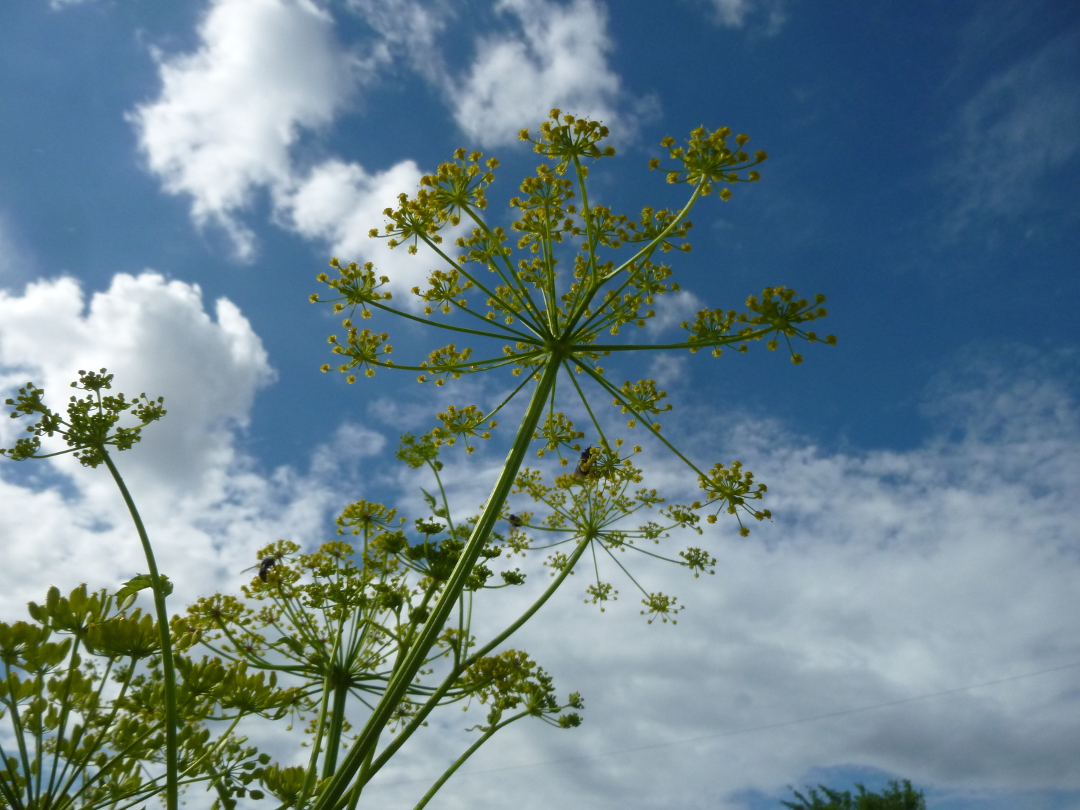
There is also a lot of hymenoptera helicopters hovering over the Ammi (I think it's bishop's lace). These umbels are crawling with patrolling wasps and syrphid flies of various sizes. I could stand and take photos here that would create an amazing stop-animation scenes in a battle. The real B-movie. Another kind of beenado is happening over the garlic chives at 16 Oaks organic Community Garden. A vosnesenskii queen and one of her brood work side by side on the umbels of one plant. While other flowers in the garden lay empty and still, these garlic chives are bristling with dramatic tension. Similar battles are going on in the oregano and those good old brassicas. A flowering broccoli plant provides an important source of fall nectar in the city.

On looking at these photographs I note that in spite of the intense competition going on there also seems to be a higher tolerance for the close proximity of other insects feeding at the same plant.

No pollen? I'm outta here!

 
In his book Bumblebees; their behaviour, ecology and conservation (2010, Oxford University Press) David Goulson asks the question: how did the introduction of honeybees half a century ago affect the native bee population in North America? Were there native bees who could not compete with the honeybees and ended up becoming extinct? I could see that happening to an oligolectic* bee, especially one that needed crucial late summer forage. We won't know if bees were lost, but we can study the bees we have now. Native bees need our support.


Fall is certainly a time when one needs to be conscious of the political nature of which plants you choose for which bees: native goldenrods and and asters need to be there in a critical mass for native bees. Abundant fall forage for honeybees means that they won't have to compete so much with native bees: garlic chives, oregano, perovskia, asters, helenium, nepeta, bee-friendly dahlias, false dandelion, sunflowers, sedum and any umbels that bloom late are essential. Also, we need to think about putting a cap on how many hives we allow per city block so that we do not stress our native urban bees to the point of extinction. I know some folks might find this hard to hear, but it's just common sense. There's only so much food at the pollinator buffet, especially as the days get shorter, floral choices narrow, and the volume of forage goes down. And soon, the rains will come.


A spider in the perovskia has a multi-course meal
 
*Oligolectic bees evolved to have a narrow choice of forage plants, ie from one genus or species.

Wednesday, June 12, 2013

My Inaugural Citizen Scientist Survey


First you have to choose a site. It needs to be close to your home and have a diversity of flowering plants. It needs to be one block long. I was having an attack of indecisiveness, but in the end I decided to start with the Mount Pleasant Park and see how it worked out. I was torn between that area and my and my neighbour's gardens. Maybe I'll do them too.


You need to choose a good bee-watching day, preferable between 10 am and 3:30 pm. It had been unsettled all morning, but when the sun finally emerged, I headed down the hill with my zucchini plant and two "Hotlips" salvias. After planting these in the plot, I searched for plants that were busy with bees. Believe it or not, the best plant was the lovage in my garden, with these little adrena mining bees.


Then you have to choose three of the plants and count the bees on each for about 3 1/3 minutes each. This wasp appeared later, when I was documenting the plant visitors with my camera.


You can see the holes chewed in these bleeding heart blossoms by nectar robbers.


 There was no action on these broad bean plants.


We have to evaluate cloud cover, wind, rain and temperature.


One of my other choices was a clump of cranesbill geranium. You can see the bumble bee sticking her tongue right into that nectary.


This is the cranesbill geranium planting I watched.


This is my first nasturtium blossom for the year.


 My final plant was borage, or as I call it, bee porridge.


Can you believe this is common garden sage? It's blossoms and calyxes are so beautiful!


This was my first wooly carder bee sighting of the season. It exhibited bullying behaviour, knocking honeybees away from the blossoms.


The cloud cover returned and I headed home for supper. I've pasted the data below for those who are interested.


Pollinator Citizen Science Data Sheet Environmental Youth Alliance 2013

Name: Lori Weidenhammer Date: Wed., June 12 Time of Day: 4:40 pm

Location: Mount Pleasant Park and Community Garden Temp: 20 C Weather: W1 CC 4 Rain 0

Plant 1: Borago officinalis

Bumblebees: 4
Hairy Belly Bees: 0
Sweat/Mining Bees: 0
Honeybees: 5
Flies: 1 (syrphid)
Other

Pollen: white full loads


Plant 2: Lovage: Levisticum officinale
Bumblebees: 0
Hairy Belly Bees:0
Sweat/mining bees: 4
Honeybees: 2
Flies: 0
Other: 1 Ladybug

Pollen: native bees had mustard yellow pollen loads


Plant 3: Cranesbill Geranium 'Rozanne'? (City Planting)
Bumblebees: 6
Hairy Belly Bees: 0
Sweat/Mining Bees
Honeybees: 7
Other

Pollen: scant load

Notes:

The journey to the site:
The sun had just come out after an overcast and unsettled morning with only about 1 mm rain. I noted a bumble bee in a bleeding heart (cultivar) as I walked to the site. There were also bumble and honey bees in a ceanothus. There are about 3 California lilacs on my eight block walk down the hill. There are also many rugosa in bloom by the sidewalks and in curb and traffic circle plantings. The Bridal Bush (Spiraea) was almost spent, whereas a week ago it was in its prime. There are several mock jasmine in bloom, one with an aphid infestation and many ladybug larvae. The lavender is almost in bloom. Nepeta in bloom. One white syringa in bloom with syrphid flies visiting.


The Mount Pleasant Community Garden Raised Beds:
2 syrphid flies on non-climbing clematis
nasturtiums--no visitors
kale flowers: lots of bumble bees and honey bees
white clover: no action
thyme: nothing
pea blossoms (many): no action
salvia officinalis: honey bees and my first wooly carder bee sighting for the year--aggressive behaviour noted, defending this plant
corn poppies: no action
corn flowers: de nada
cerinthe (blue shrimp plant): bumble bee, lots of pollen
chives: no action
calendula: bumble bee
lots of tagetes: no action
crimson clover: no action
arugula: nothing
alyssum: nothing
Italian parsley: syrphid flies
lima beans: nothing
bleeding hearts: holes observed from nectar robbing


City Plantings:
yellow yarrow: no bees
Salvia (something like Purple Rain?) busy with bumble bees. There are several groupings of this plant in the park, along with the cranesbill geranium and yarrow.
white syringa: honey bees and bumble bees. These three trees are quite new.
curry plant: no action
cream-colored iris in the wet garden: nothing