Showing posts with label citizen science. Show all posts
Tuesday, July 16, 2019
Curry for Bees!
Bees surprise me all the time and today I learned that bees love curry! What I mean is, long-horned female bees seem to love the flowers of the curry plant (Helichrysum italicum). This plant is named for its scent, not its actual use in curry dishes. It's native to the Mediterranean where the plant is used in cuisine, but I've never had much luck cooking with it. The scent seems to disappear when the leaves are heated. Apparently it is used in the perfume industry to "fix" scent. The leaves are pretty and silvery and as you can see, the blossoms are a lovely yellow color. And these Melissodes bees were tucking in!
I'd pretty much given up on it as a bee plant, but these ladies proved me wrong and you'll find it in an herb plot at the Riley Park Community Garden.
You can see how the flowers resemble the centres of this thread-leaved coreopsis, another Melissodes fave.
It also looks like these pearly everlasting blossoms, another plant that Melissodes bees love to feed on. Does this mean we'll see the same insects that like these plants on the curry plants as well? We'll have to look for hover flies like this on the curry blossoms.
This wasp is nectaring on the pearly everlasting. Will we also see this species on the curry plant? Tune in on Saturday for the answers to these questions and more!
Salivating for Salvia
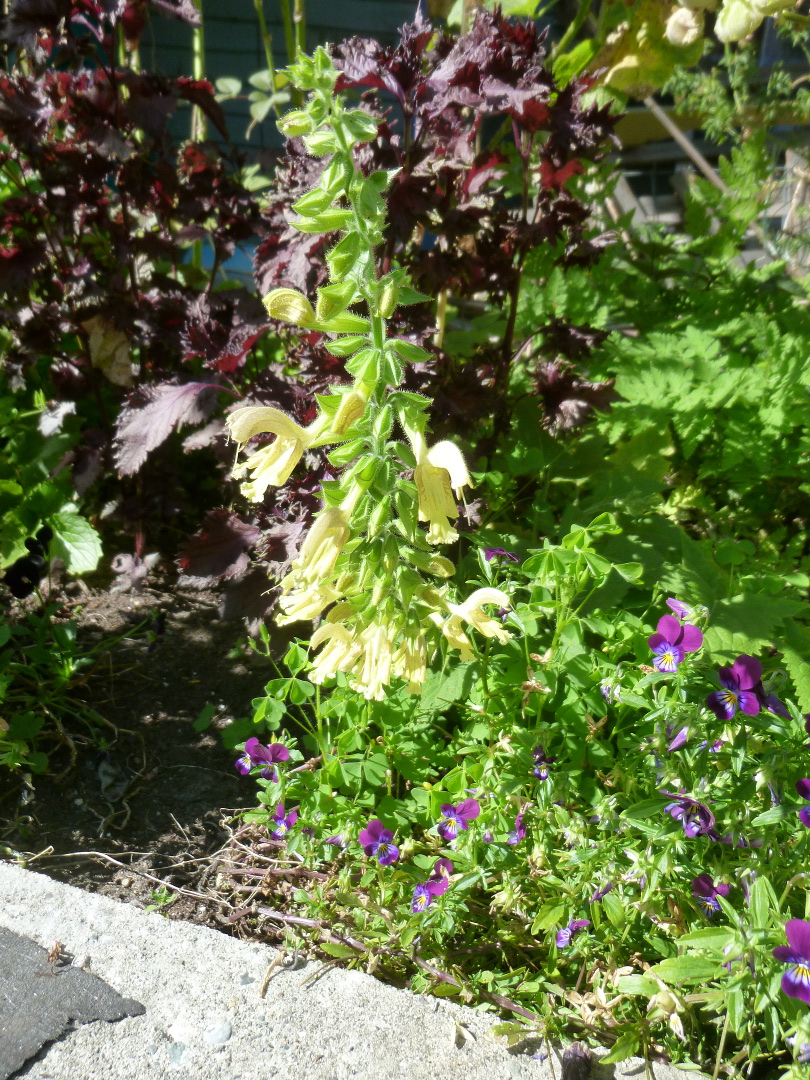
When I was looking for bees in this sage plant, a female Anna's hummingbird swooped in and starting boldly sipping nectar just inches away from me. These birds are on a schedule and they're not going to let some nerdy bee photographer put them off. They have a knack for knowing how long it takes for key plants to refill with nectar and then they make a time table of their garden tours. There are three key plants in the garden I've seen them nectaring on: Monarda didyma, Verbena bonariensis, and this sage (I'll find out which species it is and put the info here). Have you seen the hummers visiting plants in the garden?
And then there's this character, who also loves this sage plant. This is a male European wool carder bee and he is jealously guarding the plant and keeping tabs on "his" females. He likes to perch on nearby plants, including this fading clover blossom.
The female goes in for the nectar and you can see the male hovering above her so no other male gets in and tries to mate with her. Yeah, he's THAT guy. So check out these sage plants at the garden in the pollinator border and see if he attacks any other pollinators that try to get some of that sweet nectar. As an introduced pollinator, does he make it difficult for native pollinators to feed in the garden? What implications might that have in the way we choose plants for this site?
Speaking of nectar, check out those amazing markings on the flower, called nectar guides, that signal the pollinator where the sweet stuff lies. Notice that reddish sheen on the flower? Hummingbirds are often more attracted to red plants than any other colour, but there are many exceptions. Do they somehow perceive the red highlights on this purple and white flower? In any case, they make the flower beautiful to human eyes as well!
Friday, June 24, 2016
EYA Citizen Scientists at Moberly Arts and Cultural Centre
The women of CSI Moberly: Citizen Science Investigation at your service!
Erin graciously agreed to introduce students at Moberly Elementary to the world of bee biodiversity.
"Are these bees dead?"
"Well honey, they're not sleeping!"
Erin teaches grade three students how to get up close and personal with pinned bee specimens, respecting their fragility.
To see bees is to love bees.
Well, we have the remains of a June bug on the left and what I'm pretty sure is a European chafer beetle on the right.
Practicing TLC for the DPB (Dead Pinned Bee).
Meanwhile, in another part of the urban jungle . . .
A paper wasp munches on a juicy spider. . . or is it a harvestman, aka daddy longlegs?
What we think is a common eastern bumblebee (Bombus impatiens) gathers pollen from California lilacs.
Compare the male Melissodes and its long antennae with the female below.
She's the one who wears the pollen pants in the family.
Female . . .
and male.
Note that the tail from this swallowtail in missing. Perhaps chomped on by a bird?
Friday, April 15, 2016
Become a Citizen Scientist!
It's the time of the year to join EYA's citizen science program! Here's the call for participants:
EYA's Pollinator Monitoring Program is starting soon! Register until May 1st through the online registration form. Engage with your community as a citizen scientist by learning to identify bee species and collect data. Monitoring bees will help inform communities across the city of our native species and promote protecting their habitat into the future. Meet friends, gain fieldwork experience, and contribute to environmental science!
Training Days: During Day 1 (May 7th) participants will learn proper survey technique and how to identify four groups of bees as well as wasps and syrphid flies (all pollinators), and the differences between all groups. Day 2 (May 8th) will include practicing our techniques in observation with live bee identification and practice at survey recording. Register to participate in as many scheduled pollinator monitoring events as you wish! You MUST attend training to participate in the monitoring sessions.
Pollinator Monitoring Dates:
May 7 & 8 10am - 3pm TRAINING
May 11th 10am - 12pm TRILLIUM PARK/ STRATHCONA COMMUNITY GARDEN
May 18th 1pm - 3pm HASTINGS FOLK GARDEN (117 E. Hastings)
May 25th 10am - 12pm VANDUSEN BOTANICAL GARDEN
May 28th 10am - 12pm BRIDGEPORT INDUSTRIAL PARK POLLINATOR PASTURE (Richmond)
June 8th 10am - 12pm OAK MEADOW PARK (Vancouver)
June 15th 10am - 12pm UBC BOTANICAL GARDEN
June 22nd 10am - 12pm MOBERLY POLLINATOR GARDEN
July 6th 10am - 12pm OAK MEADOW PARK (Vancouver)
visit www.eya.ca for more information
EYA's Pollinator Monitoring Program is starting soon! Register until May 1st through the online registration form. Engage with your community as a citizen scientist by learning to identify bee species and collect data. Monitoring bees will help inform communities across the city of our native species and promote protecting their habitat into the future. Meet friends, gain fieldwork experience, and contribute to environmental science!
Training Days: During Day 1 (May 7th) participants will learn proper survey technique and how to identify four groups of bees as well as wasps and syrphid flies (all pollinators), and the differences between all groups. Day 2 (May 8th) will include practicing our techniques in observation with live bee identification and practice at survey recording. Register to participate in as many scheduled pollinator monitoring events as you wish! You MUST attend training to participate in the monitoring sessions.
Pollinator Monitoring Dates:
May 7 & 8 10am - 3pm TRAINING
May 11th 10am - 12pm TRILLIUM PARK/ STRATHCONA COMMUNITY GARDEN
May 18th 1pm - 3pm HASTINGS FOLK GARDEN (117 E. Hastings)
May 25th 10am - 12pm VANDUSEN BOTANICAL GARDEN
May 28th 10am - 12pm BRIDGEPORT INDUSTRIAL PARK POLLINATOR PASTURE (Richmond)
June 8th 10am - 12pm OAK MEADOW PARK (Vancouver)
June 15th 10am - 12pm UBC BOTANICAL GARDEN
June 22nd 10am - 12pm MOBERLY POLLINATOR GARDEN
July 6th 10am - 12pm OAK MEADOW PARK (Vancouver)
visit www.eya.ca for more information
Saturday, May 9, 2015
Friday, August 9, 2013
More BUM in your Garden Equals More Bees: Brassicas, Umbels, Mints
After finishing up my fifth and final citizen scientist survey counting bees in Mount Pleasant Park and Community Garden, I have some insights about the common garden cultivars that bees love. First of all morphology, or the way flowers are shaped is very important. If you imagine flowers to tiny cups for bees, you start to see which cups bees prefer. Bees love the simple cross-shaped blossoms of brassicas, the tiny cups of umbels, and the miniature bilaterally symmetrical blooms of mint. The nectar rewards from three kinds of plants can attract all sizes of native bees and honey bees.
Also, note the spearlike shape of the spearmint infloresence. This cone-shaped collection of florets is often attractive to bees.
Pollen rewards are also important. As you can see here, this bumble bee has a big wodge of ivory or grey pollen on its hind legs. Pollen and nectar also contain the chemical constituents of the plant which affect it odor, flavor, and medicinal properties.
You can see here in these fennel florets that they are shaped like tiny cups. Fennel pollen grains are quite large, turning the legs of this tiny pollen pants bee quite yellow, which is why I thought she was a wasp when I saw her first.
But you can see here she does have quite a fuzzy head and thorax.
This plant is a new bee plant I'm growing for the first time in my back yard. It is a cultivar of Angelica Sylvestris called 'Vicar's Mead.' I couldn't pass up a plant with a name like that! This past week it has been very popular with all sorts of bees. I asked a blogger named Marc Carlton from England about this plant since it was on his website and he kindly explained that this is a purple cultivar from a native British plant that is normally green. I highly recommend his website www.foxleas.com. It has excellent information on gardening for bees and Carlton is an inspiring and lyrical writer. He has real experience of watching bees in his garden to see which plants are active. I love this quote from an article called "How to choose plants that support pollinators: creating a new paradigm for 'native'":
"My pollinator border is a “terrestrial coral reef”, not only a mass of disparate shapes and colours, but alive with the movement of small creatures – but insects, not fish."
--Marc Carlton, www.foxleas.com
I have been thinking about that quote all summer and it has inspired me in ways I will share with you soon.
I wonder if this little bee is collecting pollen here or from the adjacent fennel plant.
My fennel is absolutely noisy with bees of all sizes. Then the shade hits the plant at dinner time and it falls silent. Bees go home to bed. They fly toward the Nasanov signals that their hive mates are using to call them back to the hive. The chemical constituents in the Nasanov perfume are some of the same that attract bees to flowers.
There's the phenology of blooms that affects whether bees will feed from them and also a floral clock of sorts. Bees seem to have an innate preference for certain types of flowers over others, but their choice is also determined by proximity to their home base, especially at night when they are topping up before they go home. I see hummingbirds heading for specific plants for a long feed: ie monarda, buddleia, and crocosmia, and then they top up with other various plants in the proximity before they head home. They seem to know how much food they'll need before they head home and try to make it through the night on the food they've consumed.
Some plants have long bloom periods, but short nectar runs. It seems the same way with pollen, which is why this week I've finally seen bees on yarrow and marigolds, even though they have been blooming for months.
And on a completely different note my monarda is blooming! Can't you see this as part of a Hummingbird coral reef!
As is this wacky salvia which the tag told me was supposed to have blue flowers. Oh well. It's pretty amazing. And a reminder that many sages are also great bee and or hummingbird plants. Like mint, they have bilaterial blossoms. The salvia with larger longer nectaries suit hummingbirds and the smaller blooms suit bees.
Thursday, August 8, 2013
Skippers and a New Insect Hotel
I have been noticing a lot of skippers lately all around the city. They are so plucky and playful. I like their attitude. This is a skipper in the snowberry (still blooming!!!) at the Moberly Cultural Herb Garden. (Have you got your red dress for the party this Sunday????)
This is a small buddleia at the Oak Meadows park. It is a shame that most buddleia are invasive* here in Vancouver because they are great bee, butterfly and hummingbird plants. In fact, after I took this picture, I stood up and startled a hummingbird feeding from this plant. This afternoon I spent a good ten minutes watching an Anna's female feed in my neighbor's towering 18 ft buddleia. The bees were all over it as well. The Anna's even fought with a smaller hummer (perhaps a female rufous) to defend "her" bush. There was no squeaking, just the clacking of beaks like tiny swords. About a half and hour later there was a flock of bush tits in the buddleia, feeding on bugs. It was funny to see them land on a branch and sproing up and down on it.
You can see her tongue go into the orange center of the floret.
Erin Udal from the Environmental Youth Alliance says the yarrow in Oak Meadows Park has bee supporting the bees since the lupins finished. We discussed how plants like yarrow can be empty in some gardens and teeming with insects in others.
There are a variety of wasps out now and bees that look like wasps, so it all gets very confusing. But this wasp is acting like a bee.
These twins love phacelia.
This is an empty ladybug pupae case on tansy, which is an escaped old world herb. The honey bees and bumble bees were visiting this plant as well.
Check out this fabulous new insect hotel made from a decommissioned phone booth by Contexture Design!
*You must cut off the seed heads of the buddleia before they mature. Plant breeders are developing less fertile cultivars, but the pollen and nectar rewards may not be the same as the weedy ones. We have one that grows out of a crack in the sidewalk in front of our house.
Subscribe to:
Posts (Atom)