Showing posts with label yellow. Show all posts

Sunday, September 4, 2011

Celandine Yellow

My friend Robin gave me some greater celandine (Chelidonium majus) plants for a dye experiment. She says they are somewhat weedy, so it was no problem to pick a handful with the roots. The stems and the roots ooze a bright yellow liquid. It is considered an invasive plant in North America if it escapes the garden and moves into the woods or other natural areas. Its latex sap is a skin irritant and the plant is toxic. How charming!

I simmered them in water for half and hour and then put them in a jar with some pieces of cotton mordanted in tannin. I just put the jar in the garden in the sun for a day or two.

The cloth came out a lovely soft, buttery yellow.

Robin has created her garden with an artist's eye. It's always a pleasure to visit and feast on its colors and textures.


Monday, August 29, 2011

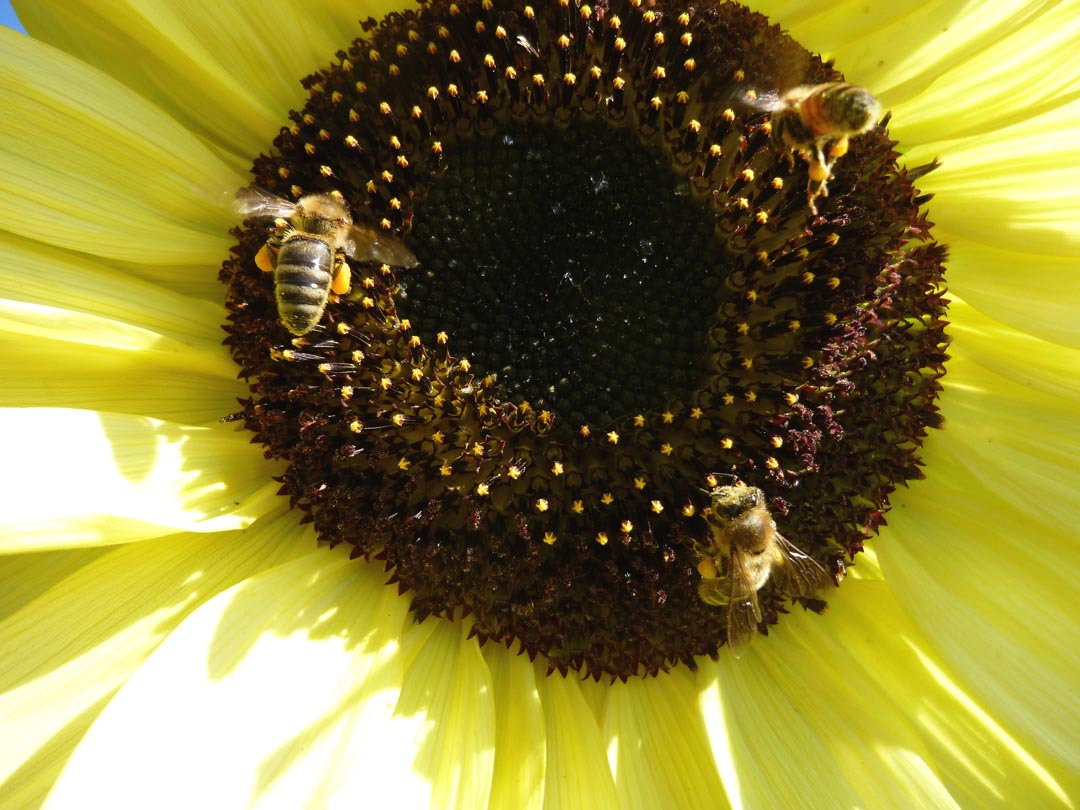
UBC Farm Sunflowers and Bees

We are finally getting some nice dry heat in August, although as I write this, it is overcast and cool. This is the best time to moon over the beautiful sunflowers at UBC Farm and watch a variety of bees sipping the florets. Sunflowers are composite flowers, made up of hundreds of mini flowers. Each of these florets sits atop an achene which contains a sunflower seed that plumps up and becomes viable if and only if its floret has been visited by a pollinator.

You can buy bouquets of sunflowers at the UBC Farm market on Saturdays, or you can purchase them by the stem. UBC Farm can also provide flowers for weddings and other special occasions.


Friday, August 5, 2011

School Garden Chores

The bumble bees were sleeping in this morning when I went to water the school Art Garden. Sadly, I couldn't get water to the garden because for some reason the tap is turned off, most likely due to work on the water mains by the city. On Monday I'll have to water, even if it means a bucket brigade from the kitchen sink.

In the mean time the weeds are thriving, so I put in an hour of weeding and gave myself a classic weeding blister in the middle of my palm under my glove. Ouch!

This looks like a very snuggly place for a nap.

I'm thrilled the garden has become a haven for the bees.

Now that the August plants are blooming, some surprises are showing up in the flowers. Some of the rudbeckia are smooth-stemmed, like this one.

Some are hairy-stemmed, like this one and some are actually echinacea. I think that's great. I like surprises.

Most of the blue-eyed widow grass is blue, but....

this sisyrinchium is yellow and the bees love it!

August means we have some scarlet red flowers to pop out against the green foliage.

I know hummingbirds love these crocosmia, but this is the first time I've seen a bumble bee take a dive inside one.

This is from the garden created by the VSB gardeners that wraps around the school. I love the scarlet of these blossoms against the blue grey of the grass.

The thread-leaf coreopsis is blooming.

And we have some echinops, which are great plants for children's gardens. Luckily we have a summer camp using the school so they can appreciate all these August blooms.


On the way home I passed by my neighbor's spirea which is an excellent native bee plant for Vancouver.

Saturday, July 30, 2011

Elecampane Experiment

A couple of years ago I discovered this plant at VanDusen Gardens. It was tucked way in the back west and I was thoroughly charmed by the brown and yellow variations in the blossom heads. I finally figured out that it is elecampane, or Inula helenium. It was one of the featured flowers at VanDusen Gardens last week and so I was able to identify it. They have planted a stand of it near the front entrance along with a bunch of other plants that bees love.

In looking for information on elecampane I discovered a website from the Pagan Rights Coalition that gives very detailed information on the medicinal benefits of this plant. Elecampane has been used to treat skin problems in farm animals, and bronchial, heart, and blood sugar ailments in humans.

The name elecampane comes from the belief that Helen of Troy carried a bouquet of the flowers when she was kidnapped by Paris. Some of the other names such as scabwort and horseheal come from its treatment of skin diseases in sheep and horses. Some other olde worlde names include elf wort, elf dock, velvet dock and wild sunflower.

Since it is in the sunflower family, one might expect that the leaves and flower heads can be used as a yellow-green dye. I have a pot of flower heads on the boil right now. A few plants ended up in the MOP garden as a wee gifty from the fairies. We don't know where they came from. Since the bees love them, I collected flower heads that were fading and wilting and left the more robust heads as a source of nectar and pollen. Some sources suggest that the roots were used in traditional Scottish dyes, perhaps as a mordant to be used with "blaeberries." Another source, digherbs.com cites using the roots as a dye with "whortleberries" and ash. I will have to experiment with that after we've collected some seeds. The plants seem to thrive here, so if you have a large garden, it would be worth trying to grow these. Nicholson's Herb Farm has a good blog post on propagation tips for Inula helenium. In the mean time, please look for the flowers at VanDusen Gardens or the MOP and have fun watching the bees!